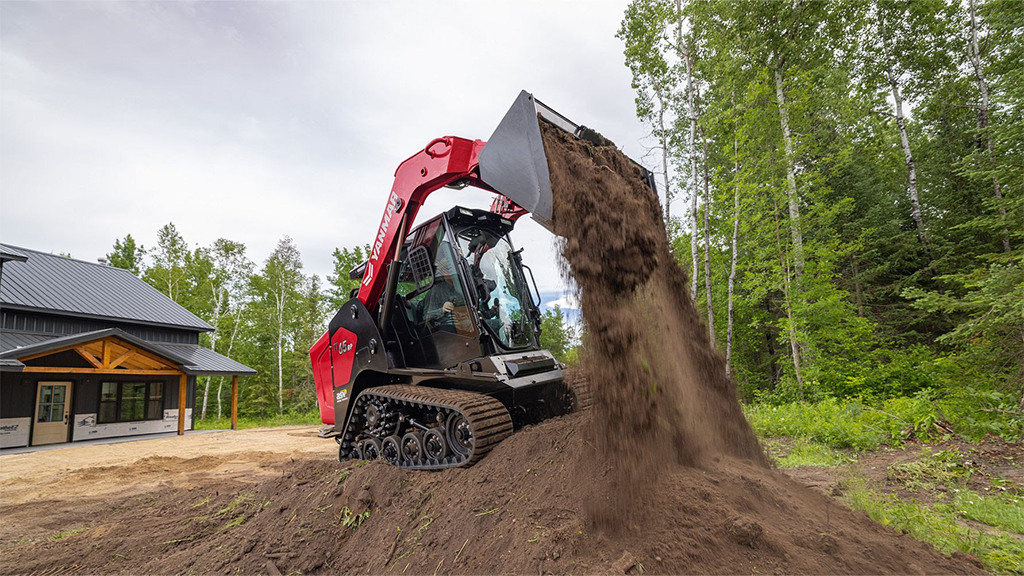

Tech-packed Yanmar mini excavator highlights the evolution of Japanese engineering
Remote operation, a tip-over mitigation system, and 3D machine control allow the ViO30-7 to take a more active role in construction
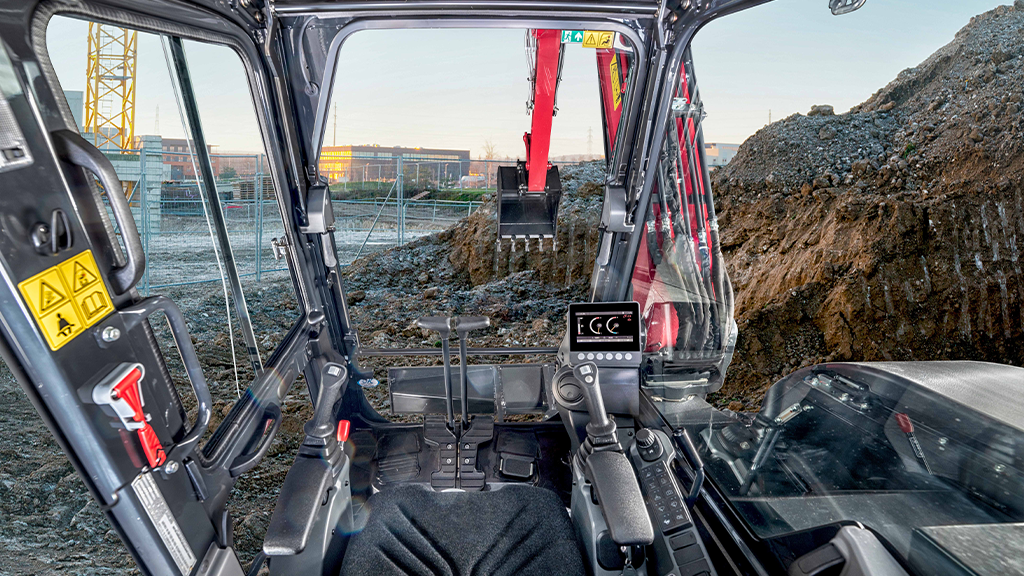
At CSPI-EXPO 2026 in Chiba, Japan, interest in automation and digital transformation was driven by a practical concern: the construction industry is looking for ways to respond to persistent labour shortages.
Yanmar Compact Equipment presented its ViO30-7 zero-tail-swing mini excavator with blade 3D machine control, alongside remote-operation technology, and its Active Tip-over Mitigation System at the Japanese convention. Together, the technologies aim to support a shift in mini excavator capability. The ViO30-7 is currently available in the Asia, Pacific, and Latin American markets.
For Cédric Durand, chief product officer at Yanmar CE, the purpose of integrating people and technology has everything to do with solving real-world problems. "The question is always how a solution performs in real conditions," he explains. "It has to integrate into the way people work."
Compact equipment brings technology into restricted spaces
In 1968, Yanmar introduced the YNB300 to meet Japan's construction boom amid labour shortages and increased costs. The machine brought mechanization into spaces that larger equipment struggled to reach. The zero-tail-swing design on the ViO30-7 answered the same need by making confined work more manageable.
Although the technology has changed over time, the development logic remains the same. Engineering begins with the performance crews need. Testing in real-world scenarios is necessary to ensure that controls last during long shifts, in rental scenarios, and for operators working with widely varying levels of experience.
"You learn different things beside a machine than you do around a design table," says Durand. "A small source of hesitation, repeated throughout the working day, can become the starting point for a meaningful change."
The recently launched SV10 shows how that process works in practice. The machine was meant to reach the market earlier, but field testing with customers in Italy, the U.K., and France identified a concern around stability. While the overall response to the prototype was positive, Yanmar decided to hold back the launch and address the issue.
The development team made targeted changes to the undercarriage and track structure, as well as the rear counterweight, before bringing the revised machine to market. Yanmar CE ensures that feedback from the field directly influences the finished machine.
"Feedback becomes valuable when it changes a design decision," Durand shares. "The operator may never see the engineering discussion behind that change, but they will feel the difference every time they use the machine."
Technology should make the operator's job easier
As machines take a more active role in the work, the relationship between assistance and understanding becomes increasingly important. Often, the most successful intervention is one that asks almost nothing extra of the operator. Yanmar's Safety Joystick, for example, activates the controls only when the operator intends to use the machine. Accidental contact does not activate the equipment, while the controls lock when the operator leaves the seat.
Built into a familiar movement, the protection adds no display or sequence for the operator to manage. "New technologies create opportunities, but they also introduce complexity," Durand says. "The priority is to ensure that complexity does not sit with the operator."
Active Tip-over Mitigation gives the machine a more direct role in managing risk. By assessing how the payload interacts with the machine's posture on sloping ground, the system can limit certain commands as tipping risk increases.
Yanmar's Force Control research came from the challenge of future construction on the Moon, where communication delays mean machinery must respond to changing terrain without constant direction from Earth.
Working with JAXA's Space Exploration Innovation Hub Center, Yanmar tested a force-controlled robotic arm on a lunar-rover research model, including travel over soft ground and excavation. The principle was then applied to an electric prototype based on the ViO25 mini excavator, using a Series Elastic Actuator to sense and regulate applied force.
Development is continuing, with Yanmar now supporting field testing with customers on real job sites to understand where the technology can bring the greatest practical advantage. With that work still in progress, further details remain under wraps for now.
"Force Control will help make heavy lifting and handling safer and easier by precisely sensing and controlling applied force," says Durand. "The aim is to reduce physical strain and improve productivity, allowing work that once required several people to be completed more efficiently by a smaller team."
Yanmar's approach to equipment design progress
Yanmar follows two design principles: "Intrinsic Design" begins with the purpose the machine must serve. "Gentleness & Toughness" unites job site resilience with simplicity for the operator. Progress is judged by whether the engineering solves a real problem, in real conditions.
"Technologies will continue to evolve, but our measure of progress should remain practical," concludes Durand. "A development has value when people can use it with confidence in the environments for which it was designed."
Company info

840 Lily Lane
Grand Rapids, MN
US, 55744
Website:
yanmar.com/us
Phone number:
218-327-3434