
Field report: Construction innovation on display at CSPI 2026 in Japan
Technology solutions address workforce, safety, emissions, and productivity challenges
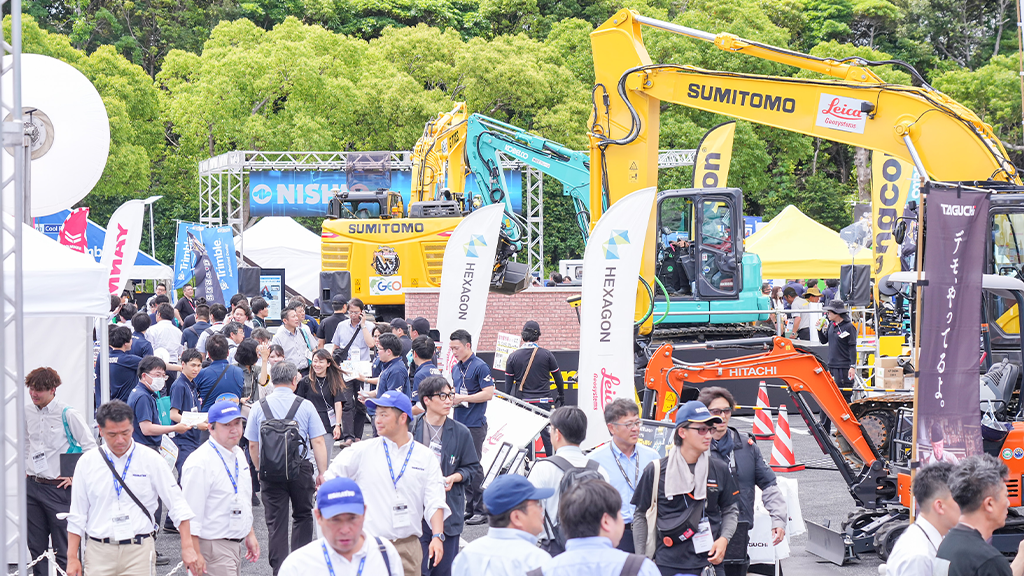
CSPI, one of Japan's largest trade shows dedicated to the construction industry, held its 8th annual event in Chiba, Japan, from June 17 to 20. The 2026 edition was the largest iteration of the show yet, with more than 600 exhibitors filling all eight halls and more than 60,000 square metres of floor space in the Makuhari Messe convention centre, in addition to an outdoor demonstration area. Attendance surpassed 54,000.
"Productivity improvement is a big theme of the whole industry," said Takahiro Takagi, CSPI 2026 show organizer. In Japan, construction industry improvements are collaborative, with the government facilitating the speed of development through its i-Construction initiative, which promotes use of information and communication technologies (ICT) in construction, Takagi explained. This has accelerated Japanese construction innovation over the past decade, and that rate of innovation is now reflected in the growth of CSPI.
CSPI is focused on innovation that drives the Japanese construction industry forward, with an emphasis on technology and equipment solutions that address the skilled labour shortage, an aging workforce, productivity gaps, and carbon emissions.
Notable trends at the 2026 show included remote operation, job site connectivity, electrification, precision technologies, and efficient equipment utilization.
Here are some highlights from CSPI 2026.
Excavators with precision dozing capability
KOBELCO's unique Blade Runner, an excavator with 6-way dozer blade, has been available for a few years now, and at CSPI the company showed that machine outfitted with precision grading technology.
Yanmar displayed a mini excavator with a similar concept, but in a much smaller size class. Compact track loaders are less popular in Japan than North America, and small dozers have historically been preferred. However, there are currently fewer small dozer models on the market. Yanmar's 3-ton ViO30-7 Blade 3DMC mini excavator, featuring a dozer blade with precision grading technology, is intended to fill that gap.
Remote operation for hazardous work
Remote operation is useful in Japan's steep terrain and for hazardous work, such as disaster recovery after earthquakes. There were plenty of solutions — and demonstrations — at CSPI. Hitachi showed its remote-operated Ready to Be Robot (RBT) hydraulic excavators. These machines are designed to be ready for more automation upgrades as technology develops.
Visitors could use Komatsu's Smart Construction teleoperation station to execute earthworks tasks on a remote job site. Operating stations were set up in a van in the outdoor demonstration area and at Komatsu's indoor booth to demonstrate portability.
Morooka demonstrated its remote-controlled tracked carrier throughout the week. From Morooka's indoor booth, an operator controlled a crawler carrier out on the demonstration lot. Morooka notes that this non-line-of-sight solution can keep operators out of dangerous heat during hotter months. Morooka's remote control for tracked carriers is not commercially available yet — the company is currently taking feedback from customers.
Electrification across size classes
Honda's swappable battery system was used to power many of the electric compact machines at CSPI. Yanmar showed a C12Re electric dumper prototype alongside an SV08e electric mini excavator, both powered by the Honda Mobile Power Pack e (MPP). Other compatible machines on display included Komatsu's smallest excavator, the PC01E, and SAKAI's walk-behind electric tandem roller, the HV620 evo. This battery solution addresses concerns over equipment downtime due to charging. When the battery runs out of power, the operator simply has to swap the depleted module for a fully charged one.
Electrification wasn't limited to mini and compact equipment: Hitachi, Tadano, and XCMG were among OEMs displaying larger electric solutions for earthmoving, lift, and material handling applications.
Japan leads connected job site solutions development
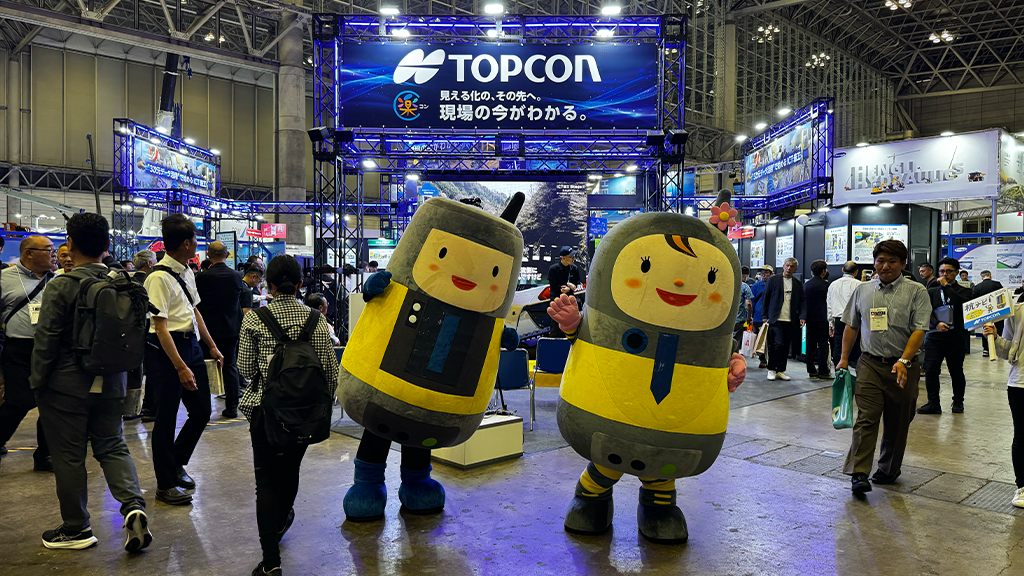
Connected job site solutions drive productivity gains in construction, and their development in Japan has been facilitated by the i-Construction framework. Topcon demonstrated its Sitelink 3D real-time productivity dashboard, which is a comprehensive remote job site management tool that gives managers up-to-date insight into operations, including as-built data, and allows them to deliver job site information to operators. At its indoor CSPI booth, Topcon demonstrated this powerful tool by showing up-to-date data on equipment operating at its outdoor demonstration area.
Smart Construction is Komatsu's digital ecosystem that gathers all job site information in one place. Komatsu was an early leader in incorporating ICT into equipment and, in alignment with the i-Construction program, has been evolving the Smart Construction platform since 2015. ICT Stage I focused on streamlining construction processes; now, in Stage II, data from the entire job site is used to optimize the project plan in advance and update it during construction.
Specialized attachments and tiltrotators
Japanese job sites often have limited space and require smaller machines to complete work. Throughout the show, application-specific attachments and quick couplers were used to demonstrate the efficiency of compact machines, particularly excavators. Specialty attachments from Japanese OEMs were also on display. Outdoors, attachment manufacturer Okada demonstrated an unusual attachment that is used to handle the large concrete tetrapods that reinforce Japanese shorelines. At its indoor display, Okada showed new attachments for forestry and sawmill work, including a saw-equipped log grapple for excavators. NPK focused on design innovation that has allowed it to make stronger demolition attachments for smaller carriers.
All of the major European tiltrotator manufacturers were present at CSPI, demonstrating the latest tiltrotator technology on compact and mid-size excavators at the outdoor exhibition area. The Open-S Alliance used CSPI to announce the expansion of the global automatic quick coupler industry standard to the OS40 size for the 2- to 7-tonne excavator segment.
CSPI will return in 2027
Next year's show is currently accepting exhibitor registration. Organizers expect continued steady growth in the visitor count, and invite North American visitors to attend the 2027 edition.
"There is frequent progress in construction, and every year there is something new to see," Takagi said. "We look forward to having attendees from overseas see Japanese technology."
CSPI 2027 will run from June 23 to 26 at the Makuhari Messe convention centre in Chiba, Japan. Learn more at cspi-expo.com.
This article originally appeared in the September 2026 issue of Heavy Equipment Guide.
Company info




840 Lily Lane
Grand Rapids, MN
US, 55744
Website:
yanmar.com/us
Phone number:
218-327-3434


90 International Parkway
Adairsville, GA
US, 30103
Website:
sakaiamerica.com
Phone number:
1-800-323-0535