
How electrification is developing in roadbuilding, cranes, and aggregates
How each sector is arriving at electrification on its own terms
Electrification is expanding the range of power options available in construction equipment. Instead of replacing diesel machines outright, electric machines are favoured in applications where operating conditions support alternative powertrains. For the question of where electric solutions deliver measurable value, the answer varies by sector, shaped by duty cycle, infrastructure, ROI, and application.
Electrification gained its earliest traction in applications where benefits were immediate and measurable. Strict emissions targets and regulatory pressure in parts of Europe helped accelerate innovation and moved electric equipment from development into active job site deployment. Lift equipment has demonstrated the practicality of battery-electric systems in controlled settings, particularly indoors. In underground mining, electric fleets reduce ventilation requirements and improve underground conditions. Electrification of compact earthmoving and demolition equipment has proven practical in municipalities, indoor environments, and rental fleets.
Today, electrification development is progressing in more demanding segments, such as roadbuilding, cranes, and aggregates processing, where power demands are higher, runtimes longer, and workflows more varied. In these sectors, the approach is less uniform. Here we examine how that development is playing out and why each sector is arriving at electrification on its own terms.
Roadbuilding
Compaction leads roadbuilding electrification
Electrification in roadbuilding is advancing most clearly in compact tandem rollers. Their defined operating patterns, moderate energy demands, and frequent use in urban and municipal environments make them suited to electrification.
Battery-electric compact rollers are now operating full shifts on street repairs, bike paths, parking lots, and residential projects. Machines such as the Volvo DD25 Electric and Hamm's HD 10e and HD 12e demonstrate the viability of electric compaction equipment. With battery capacities designed to support a typical working day and recharge times measured in hours rather than extended downtime, these machines integrate into existing workflows with minimal adjustment.
Beyond emissions reduction, electric rollers offer secondary operational advantages. Reduced vibration, lower noise levels, and fewer service points contribute to improved operator comfort and lower maintenance demands. For rental fleets and municipal contractors in particular, the simplified service profile of electric compact rollers can reduce downtime and operating costs across the life of the machine.
Advances in battery capacity and energy management have expanded electrification development into larger tandem rollers, such as Hamm's HX 70e, which has been tested on job sites in Europe, and paving, though paver development has progressed more slowly due to higher energy demands.
Electric paving gains traction
Unlike compact rollers, asphalt pavers run at higher, more consistent power levels, especially during continuous laydown on larger projects. Because of that, electric pavers are developing more gradually and are limited in their commercial use. Some electric pavers are now demonstrating full-shift capability supported by high-capacity lithium-ion battery systems and rapid-charging options.
Electric pavers, such as the LeeBoy 8520C Electric, the Vögele SUPER 1300-5e and MINI 500e/502e, the Ammann eABG 4820, and the Dynapac SD1800W e, illustrate how electrification is scaling in mini, compact, and mid-class pavers to benefit compact urban paving, municipal work, and mid-size commercial projects.
The LeeBoy 8520C Electric, with pave widths from 2.44 metres to 4.57 metres, integrates GM's battery and drive system with the company's Legend HD screed and high-flow hydraulics, positioning it as an electric paver built for commercial applications.
Vögele's SUPER 1300-5e features a 126 kWh liquid-cooled lithium-ion battery operating at 400 V and supports pave widths from 1.8 to 4.2 metres. The MINI 500e and 502e models offer 15 kWh or 22 kWh battery options designed for smaller-scale work such as pathways, sidewalks, utility restoration, and confined urban paving projects with full-day runtime expectations.
Ammann's eABG 4820, which was billed as the largest electric paver at its introduction in early 2025, delivers paving widths up to 6.5 metres and recorded daily outputs of up to 1,200 tonnes, supported by a battery system designed for full-shift operation.
Dynapac's SD1800W e is powered by a 98 kWh lithium-ion battery paired with a 55 kW electric motor (200 kW peak output), with reported recharge times from 5 to 80 percent in approximately 40 minutes. With minimum paving widths down to 0.7 metres using reducing shoes (and up to 4.7 metres), the SD1800W e can handle narrow urban applications such as pathways and utility restoration work.
Battery capacity and charging strategy remain critical considerations. Reduced noise and emissions could make compact and mid-sized electric pavers particularly effective in urban environments and enclosed spaces, for night work, and where emissions regulations influence bid requirements. Electrification development for the roadbuilding sector is shaped less by technological possibility and more by operational fit. In roadbuilding, that fit emerges most clearly where urban density, environmental standards, and bid requirements intersect.
Cranes
Flexible power strategies for mobile cranes
Electrification of mobile cranes is advancing through hybrid and plug-in systems that reduce emissions while preserving lifting performance and runtime flexibility.
This approach reflects the operational realities of mobile cranes. All-terrain and rough-terrain units operate with highly variable duty cycles and often travel significant distances between work sites where grid access can be inconsistent. Large, heavy-lift jobs require steady, high-power output. These conditions can challenge fully battery-dependent systems in larger crane classes. As a result, many OEMs are integrating electric-drive capability into conventional powertrains.
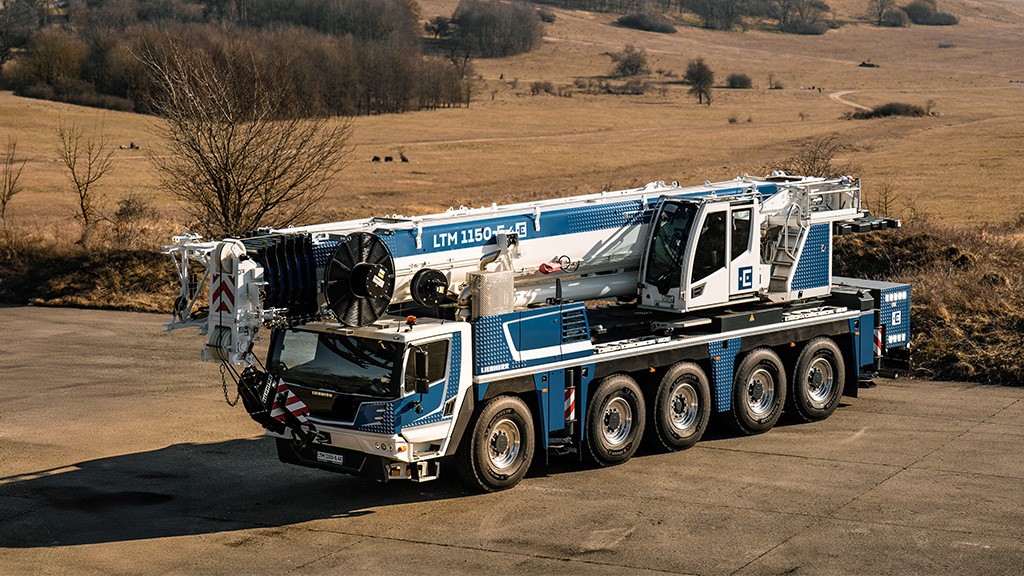
Liebherr's LTM 1150-5.4E and LTC 1050-3.1E combine conventional engines with electric-drive systems that enable emission-reduced crane operation when connected to job site power. In electric mode, lifting can be performed with reduced noise and zero on-site exhaust emissions. When grid power is unavailable, the machines retain the flexibility of an internal combustion engine.
Manitowoc's Grove GMK5150L-1e and GMK5150XLe similarly reflect the plug-in hybrid strategy gaining traction in all-terrain cranes. These models connect to external power for lifting operations, reducing fuel consumption and emissions on site while maintaining diesel-powered mobility for travel between jobs.
Fully battery-electric cranes are emerging in more defined applications. Tadano's eGR-1000XLL-1 is a fully battery-electric rough-terrain crane designed for urban and emission-sensitive environments. With up to seven hours of lifting capability or a combined lifting and travel cycle supported by its on-board battery pack, it demonstrates that full battery-electric operation is commercially viable in select crane classes.
Infrastructure shapes adoption
Mobile cranes frequently operate on temporary sites where grid infrastructure varies widely. Plug-in capability becomes a practical bridge solution. When reliable job site power is available, cranes can operate in electric mode. When it is not, diesel engines can ensure uninterrupted operation. As battery density improves and charging infrastructure expands, fully electric crane platforms may gain broader use. For now, hybrid and plug-in systems represent the dominant strategy, enabling emission reductions without compromising performance or versatility.
Aggregates processing
Plug in instead of power packs
Electrification in aggregates and materials processing follows a distinct, sector-specific logic. Crushing and screening plants operate under sustained, high-load conditions that demand continuous power over extended periods. Rather than relying primarily on on-board battery systems, many manufacturers are advancing electrification through grid-connected and diesel-electric-drive architectures.
In quarry and recycling environments, crushers and screens often remain in place for weeks or months at a time. When grid access is available, connecting directly to external power can reduce fuel consumption, lower operating costs, and eliminate on-site exhaust emissions without requiring large battery packs. Where grid infrastructure is limited, diesel-electric systems provide a hybrid solution by using diesel-fuelled generators to power electric drives more efficiently than traditional hydraulic systems.
Terex Finlay offers electrified versions of its established mobile crushing and screening platforms, allowing operators to switch between grid power and generator supply without fundamentally altering machine architecture. Electric variants of the J-1175 jaw crusher, I-120RS impact crusher, and C-1540 cone crusher reflect this strategy. These machines can connect directly to grid power or operate from an external generator, allowing operations to reduce diesel reliance while maintaining production throughput. Terex Finlay extends this approach to screening with the 883+ Electric Scalper, which powers its feeder, screenbox, and conveyors through an electric-drive system, but, like the company's other electrified machines, maintains an on-board engine for transportation. This allows screening operations to run on external power while maintaining flexibility for movement around job sites.
Keestrack's E-drive and ZERO-drive platforms represent a progressive electrification strategy. E-drive models use electric motors powered either by a grid connection or by an on-board or drop-off diesel generator, allowing operators to transition between electric and diesel operation depending on site conditions. ZERO-drive configurations eliminate on-board combustion engines entirely. The R5e impact crusher, for example, is available in diesel-hydraulic, hybrid plug-in, and ZERO-drive configurations, offering operations flexibility within a single machine platform.
Kleemann emphasizes flexible drive architectures for its crushing and screening solutions, including the new MOBISCREEN MSS 1102 PRO mobile coarse screening plant. With a diesel-hydraulic H-Drive in its standard model, an optional electro-hydraulic Dual Power configuration allows the diesel engine to be disengaged so the plant can run entirely on an external electric power supply when grid power is available. This architecture improves efficiency and reduces fuel consumption and emissions when compared to traditional diesel-hydraulic models.
SBM Mineral Processing's REMAX and JAWMAX series, including models such as the REMAX 400, REMAX 600, and JAWMAX 450, are also available in diesel-electric configurations that allow operation through an on-board generator or through direct grid connection. These architectures reinforce the trend toward externalized power sources rather than fully battery-dependent equipment.
A different kind of electrification
While roadbuilding increasingly explores battery-powered machines and cranes adopt hybrid systems to balance mobility with emissions reduction, aggregates and materials processing demonstrate a third path. Electrification, in this case, is not focused on on-board batteries. It is about supplementing diesel-powered systems with electric drives and shifting the energy source away from diesel wherever practical.
As in other sectors, the outcome is not uniform. The viability of electrification depends on site conditions, infrastructure access, and production requirements. In aggregates, the strategy is clear: plug in when possible, supplement when necessary, and prioritize continuous output above all else.
This article originally appeared in the March 2026 issue of Heavy Equipment Guide.
Company info




6030 Dana Way
Antioch, TN
US, 37013
Website:
wirtgen-group.com/america/en-us/products/voegele
Phone number:
(615) 501-0600

Eisenbahnstrasse 25, 4901
Langenthal,
CH,
Website:
ammann-group.com/en/home
Phone number:
954-493-0010


1015 Sutton Drive
Burlington, ON
CA, L7L 5Z8
Website:
liebherr.com/en/can/about-liebherr/liebherr-worldwide/canada/liebherr-in-canada.html





6030 Dana Way
Antioch, TN
US, 37013
Website:
wirtgen-group.com/america/en-us/products/kleemann
Phone number:
(615) 501-0600