
Field report: Construction industry highlights at CES 2026
OEMs showed off tech solutions designed to make job sites safer and more productive
Construction industry OEM heavyweights arrived at CES 2026 ready to show off cutting edge solutions that rise to the heady task of today's industry challenges, including labour, safety, and productivity shortcomings. Here are the construction industry highlights that I got to explore at CES 2026.
Bobcat
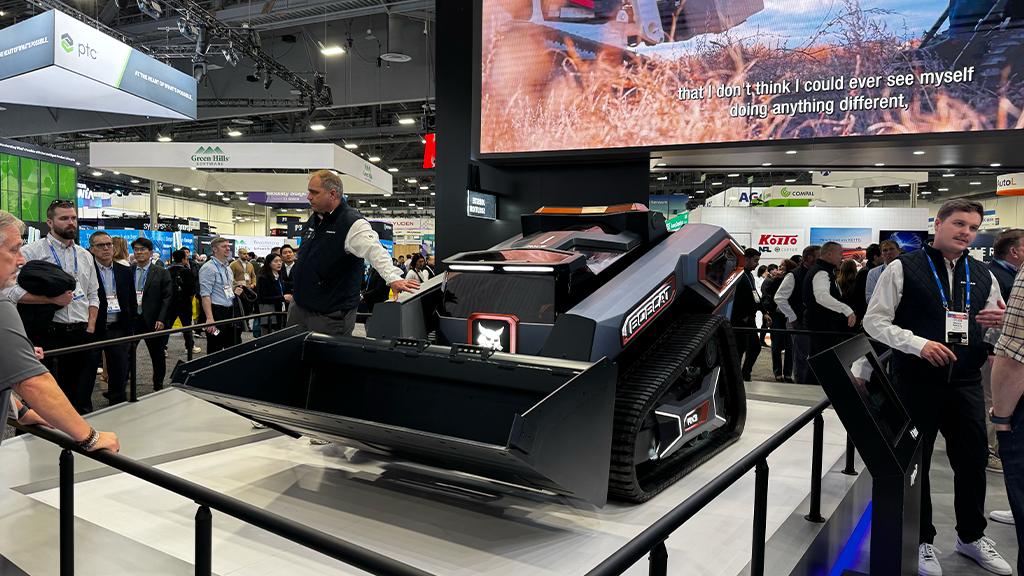
The visual centrepiece of Bobcat's CES presence was the RogueX3, the latest version of the company's experimental RogueX platform. This new iteration of the concept machine has been designed for modularity — to operate with or without a cab, and to adapt to different lift geometries, powertrains, and undercarriage configurations. The RogueX is Bobcat's experimental platform to test new machine concepts and configurations for learnings that the company can apply to its commercialized equipment line.
Bobcat also introduced the Bobcat Jobsite Companion, an AI assistant activated by a button on the joystick in the cab. The operator can verbally ask a question about the machine or deliver a command, such as "what is my fuel level?" or "turn on the lights," without taking their hands off the joysticks or their eyes away from the job site.
We've seen collision warning and avoidance technology on mid-size construction equipment, and in 2026 Bobcat is introducing these features to compact equipment, including skid-steer loaders, for the first time. These machines spend a lot of time backing up on tight job sites. With collision warning and avoidance the machine will automatically slow to a stop without making contact when detecting an obstacle or person to the rear of the machine.
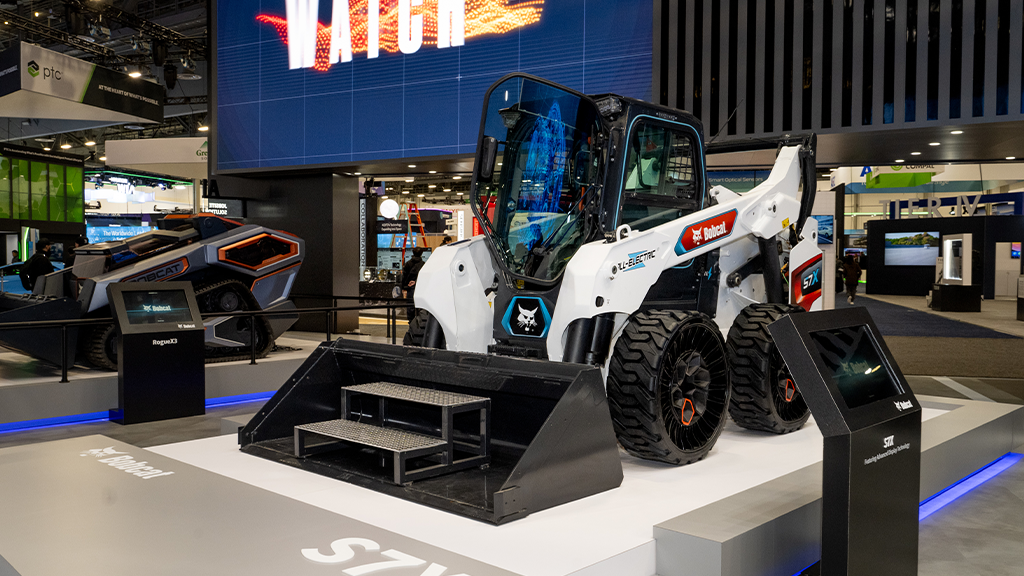
Additional Bobcat CES innovations include the Bobcat Standard Unit Pack (BSUP), a fast-charging, modular battery system; a transparent micro-LED display integrated into the cab window; and Service.AI, an AI-powered service and support platform for dealers and technicians.
Kubota
Kubota announced the commercialization of an autonomous solution, developed in partnership with Agtonomy, for its M5 Narrow tractor. The company has used vineyard operations as the test case for its autonomous technology, which can be applied to other agriculture and construction applications. Kubota demonstrated how the M5 with autonomy can gather data from the crop and provide insights into its health via a digital twin, indicating which plants have pest infestations, and which ones are healthy.
The company also showed its concept robotic platform, KVPR, which features multidirectional movement and an adaptive counterweight. It is responsive to changes in terrain and can utilize multiple attachments.
John Deere Construction & Forestry
John Deere has developed expertise in automation for the agriculture industry and is now applying it to the Wirtgen family of roadbuilding equipment. At CES 2026, John Deere focused on its automation technology that was developed for combine operations and has been applied to Wirtgen's Vogële pavers.
Smart Pave automatically controls the paving width, position, and direction of a Vogële Dash 5 paver, eliminating the need for someone to stand at the edge of the screed. This keeps that person away from live traffic and allows them to be reallocated to other productive tasks, such as prep work at the front of the machine or quality control checks at the rear of the machine. Smart Pave's precision reduces the need to err on the side of overspec, limiting material waste.
JLG
JLG won a CES Innovation Award for its boom lift with robotic end effector. The end effector was demonstrated in a simulated welding application, but can be applied to a wide variety of applications that require work at height, including painting and grinding, and is ideal for data centre construction and industrial sites, such as petrochemical facilities.
JLG demonstrated the boom lift operating in coordination with two modified scissor lifts. The scissor lifts raised a beam to height where the robotic arm could autonomously weld it into place. Even for applications where a skilled worker is still completing the work at height, JLG's technology could be adapted into an assistant to retrieve and bring them materials — a significant time savings for that worker. The robotic end effector is being tested with end users, and JLG says that the technology can be commercialized if the market is ready.
Caterpillar
Caterpillar CEO Joe Creed presented the day two keynote at CES 2026, where he made the case for the construction industry's role as a foundational part of the tech industry — "the invisible layer of the tech stack" — and highlighted a new partnership with NVIDIA.
The company demonstrated its new Cat AI Assistant, showing how it can be instructed to set machine parameters, like an E-Fence, or provide operational information to the operator. The system is designed to help novice operators better understand their machine, and Caterpillar plans to develop it into a more sophisticated training tool that can provide operator feedback.
Chief Technology Officer Jaime Mineart unveiled the next frontier of Caterpillar's long-running autonomy program: the construction job site. Caterpillar has a successful track record of full-autonomy operations in mining, and is currently testing full autonomy in quarry applications.
Caterpillar says that full autonomy for equipment in the construction industry, long thought to be a pipe dream given the dynamic complexity of construction job sites, is now within reach due to advances in on-board computing. The company will focus on developing autonomy for five construction machines: wheel loaders, dozers, excavators, ADTs, and compactors.
This article originally appeared in the January 2026 issue of Heavy Equipment Guide.