

RodRadar brings real-time underground utility detection to excavator buckets
Live Dig Radar technology helps operators identify buried utilities as excavation progresses, with machine-control integration adding automatic strike prevention
Before breaking ground, contractors need to answer a critical question: what is buried on the job site?
Utility records, One Call services, electromagnetic locating, ground-penetrating radar (GPR), and physical verification all help contractors identify buried infrastructure before excavation begins. Yet utility strikes remain a persistent problem, in part because records can be incomplete or inaccurate, and what is actually underground does not always match the information available to the contractor.
RodRadar is approaching this problem from a different point in the excavation process. The company's Live Dig Radar (LDR) technology extends utility detection into active excavation by putting GPR technology directly on the excavator bucket. RodRadar's LDR Excavate system gives the operator another opportunity to identify buried infrastructure at the start of the digging process and at intervals throughout the excavation.
"The whole industry is focusing on pre-project activities," says Yuval Barnea, VP of sales and marketing at RodRadar. "We are not saying stop doing all the work that you're doing," Barnea says. "You have to, by law, . . . contact 811, use whatever methods that you can to get as accurate information as you can, do surveying before you go on the project site. But everybody knows that it is just not enough."
Bringing ground-penetrating radar to excavator buckets
Conventional GPR surveys are typically conducted before excavation using an antenna moved across the ground by hand or mounted on a cart or vehicle. The system sends electromagnetic energy into the ground and analyzes the reflected signals to identify subsurface features. RodRadar applies that technology differently with the LDR Excavate bucket and its integrated Live Dig Radar technology.
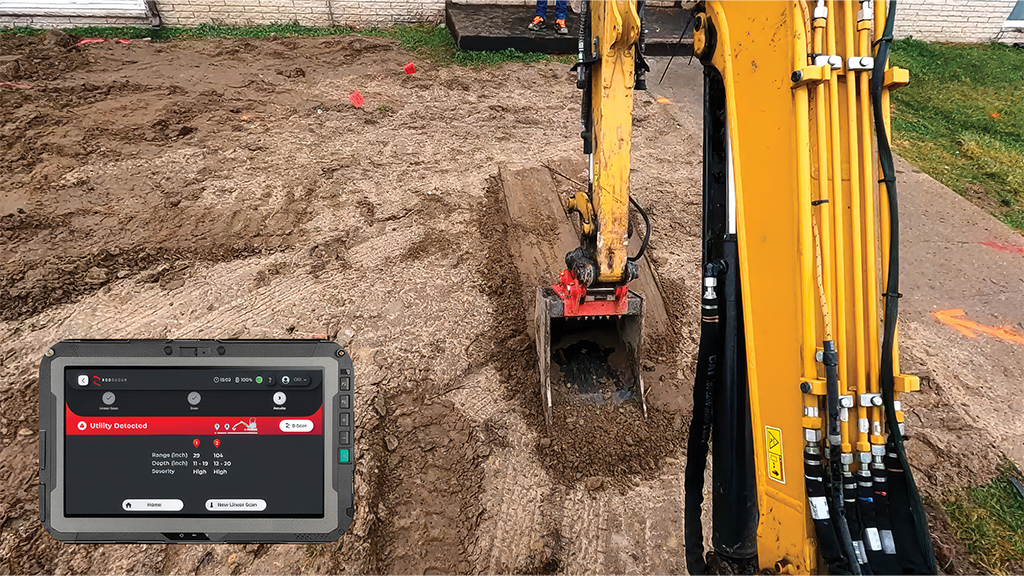
To scan, the operator places the bottom of the bucket against the ground and moves it across the area to be excavated. Reflected radar signals are processed automatically, and audio and visual results appear on the LDR Visualize tablet in the cab within seconds. The display identifies where a potential utility was detected and provides a depth range. The system processes the radar data automatically, eliminating the need for the operator to interpret raw sensor data.
LDR Excavate is designed to scan approximately one metre below the bucket at successive stages of the dig. If the scan confirms that the next layer is clear, the operator can excavate to that depth before scanning again to check for utilities farther below. As the excavator works downward, the radar moves with it, reducing the distance between the sensor and deeper infrastructure.
If an object is detected but is sufficiently far below the bucket, the operator can remove a layer of material, pause excavation, and scan again.
Detection is not limited to a particular utility material. LDR's algorithms look for the characteristic radar reflections created by buried infrastructure while filtering out other signals, and the system identifies a potential utility without determining exactly what it is.
"It doesn't matter. We don't care whether it's metal [or] plastic because it can be anything," Barnea says. "It can be a power line conduit, high voltage, low voltage. It can be a plastic conduit with fibre-optics inside. It can be a gas pipeline."
Accurate detection still depends on proper scanning technique, including sufficient overlap between passes. For the operator, what matters is how close that buried infrastructure is to the next digging pass.
"We call it peeling the onion. Getting closer to the target, and, as [the operator] progresses, getting the information [needed to] avoid the utilities," Barnea says.
If the detection is close enough that excavation should not continue, the operator stops, and the utility can be exposed using the appropriate method.
From detection to automatic stop
RodRadar's next step has been to connect real-time underground detection with machine control. Through an integration with Hexagon's Xwatch safety system, a detection can trigger a depth restriction that prevents the bucket from travelling below a predetermined threshold above the detected object.
RodRadar calls the integrated system Stop Before Strike (SBS), and Barnea compares the progression to automotive driver-assistance technology. First it provides the driver with a warning, then it adds a system capable of intervening. The operator retains authority over the machine and can override the stop.
"It's [the operator's] decision," says Barnea. "But it has to be a conscious decision."
The Xwatch integration is not intended to be exclusive. RodRadar designed LDR to support integration with other machine control and safety systems, and Barnea says the company is working with other industry technology providers.
Turning underground utility detections into project data
LDR's detection data can also have value after the immediate hazard has been avoided. LDR Insight is a cloud-based management portal that allows project stakeholders to access data generated in the field.
Connected to the LDR Insight management portal, the LDR Capture mobile app allows contractors to document a detected utility once it has been safely exposed, including information about what it actually is.
RodRadar is also working to add geolocation to detected utilities so that more accurate as-built information can be incorporated into contractors' project data.
RodRadar expands Live Dig Radar bucket options for excavators
RodRadar's LDR Excavate solutions span excavators from approximately 1 ton up to 40 tons, and customer demand has also driven development of narrower bucket options for compact machines.
U.K. utility contractor Network Plus asked RodRadar to develop a 12-inch-wide LDR bucket for compact excavators used for repair and maintenance work in congested urban environments.
"We downscaled the solution to a very small bucket that can fit even the smallest machines," Barnea says.
The system can be installed on new or existing excavators because the LDR Excavate bucket attaches to the carrier like any other bucket. The radar hardware itself, however, cannot simply be added to an existing bucket. The antennas and electronics are incorporated into a purpose-built structure designed to withstand excavation loads and shocks.
RodRadar works with bucket manufacturers, including AMI and TAG, as well as attachment system manufacturers, such as engcon and OilQuick. With integrated quick-coupler systems, connecting the LDR bucket also connects its power and data, making it easier for operators to switch between the LDR bucket and other attachments.
Making Live Dig Radar part of the dig
Adding an LDR scan right before digging, and as the excavation progresses, introduces another step into the operating cycle. Barnea says that the added time should be weighed against the downtime that can follow a strike.
"It doesn't take a long time. I mean, a few seconds of a scan, a few seconds to get the result, then you act accordingly," he says.
The technology also has to work for the people using it. RodRadar has focused on automating signal interpretation so operators do not need GPR expertise, and training is focused on how to use the system effectively during excavation.
"You can have the technology as amazing as possible integrated into the machine, but if you don't have these easy automatic algorithms that provide . . . data [that is] very easily understood by the operators, it's not going to mean anything."
For RodRadar, the longer-term objective is to make real-time detection another routine layer of excavation safety. The pre-dig locate process tells a contractor what is expected to be underground. Live detection tells the operator what is beneath the bucket as they dig.
This article originally appeared in the 2026 Excavators special issue of Heavy Equipment Guide.