
Liebherr enters the 22-tonne class with its new Litronic railroad excavator
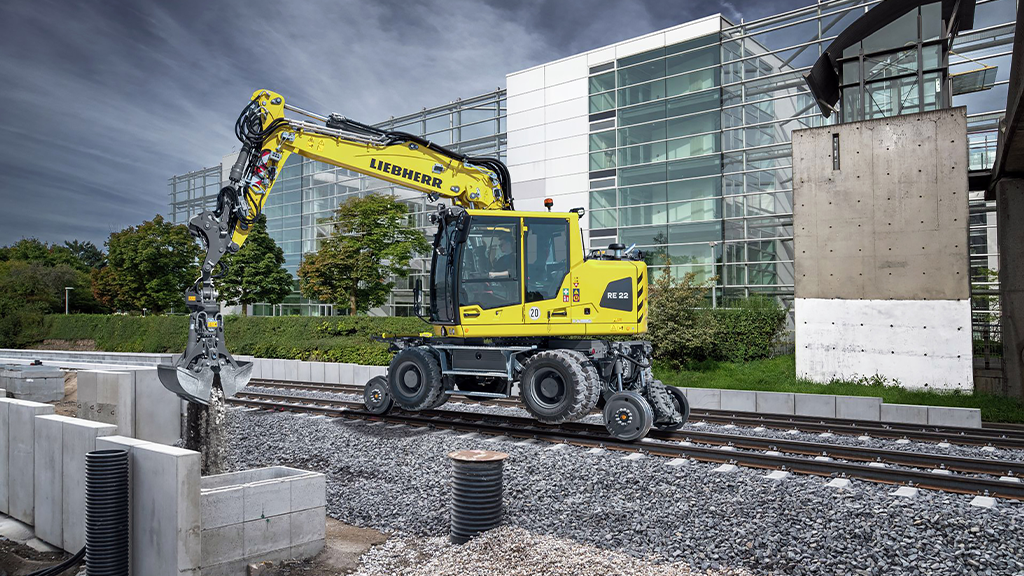
The hydrostatic rail-wheel drive on the RE 22 M allows the machine to travel with the undercarriage lowered and the boom raised
Liebherr has been developing railroad excavators since 1967 and is marking a launch into a new weight class with the RE 22 M Litronic railroad excavator. With a 22-tonne operating weight, the RE 22 M is designed to deliver versatility and performance with a 120-kW engine, along with a range of advancements.
The machine features a standard rear swing radius of 2,000 mm, increasing to 2,110 mm with an optional heavier counterweight package, subject to approval. A completely redesigned dual cab and the latest INTUSI operating concept further enhance operator comfort, ergonomics and ease of use, helping to maximize efficiency on site.
An all-new undercarriage design allows for versatility on the job
A key innovation of the RE 22 M is its newly developed rail undercarriage, which is fitted as standard across the new generation and is currently the subject of a patent application. The hydrostatic rail-wheel drive system allows the machine to travel with the undercarriage lowered and the boom raised. Alternatively, when equipped with road tires, the RE 22 M can operate with the undercarriage raised and the tyres running directly on the rails, generating the traction required for travel while helping to protect rail infrastructure.
This unique concept allows the machine to both travel and work in different operating positions, providing greater flexibility and efficiency on site. The capability is made possible by a completely redesigned rail undercarriage mounting and suspension system.
Further enhancing performance, the oscillating axle automatically adapts to operating conditions. When the machine is working, the axle locks into position to maximise stability. During travel, it remains free to oscillate, ensuring optimum traction and ride quality. The newly developed rail axle delivers a tractive force of 50 kN and, subject to country-specific approval, enables travel speeds of up to 40 km/h. In emergency situations, the machine can also be towed at speeds of up to 60 km/h.
For applications requiring even greater lifting and load-bearing capabilities, the RE 22 M can be equipped with a centre-mounted two-point support system. Despite its increased stability, the design remains compact, preserving visibility around the machine and allowing efficient operation in confined work environments. Thanks to its patent-pending kinematics, the support system remains close to the machine even when fully extended, adding minimal overall width while delivering maximum versatility on site.
A low-maintenance design in the upper structure creates simplicity for operators
The RE 22 M builds on the proven design of its predecessor, the A 922 Rail, retaining the upper structure that provides ground-level access for routine maintenance and servicing. A range of counterweight options allows the machine to be tailored to specific operating requirements, ensuring optimum performance across a variety of rail applications.
Operator comfort has also been enhanced with a redesigned dual-cab concept, featuring a dedicated driver's position in the upper cab section. The RE 22 M is equipped with a Comfort seat as standard, providing a high level of ergonomics throughout the working day.
As well, with the INTUSI adaptive operating concept, the control panel previously mounted on the steering column beneath the steering wheel is no longer required. Instead, these functions are fully integrated into the INTUSI display, creating a cleaner cab environment while ensuring an unobstructed view of the working area.
Company info

1015 Sutton Drive
Burlington, ON
CA, L7L 5Z8
Website:
liebherr.com/en/can/about-liebherr/liebherr-worldwide/canada/liebherr-in-canada.html