
A convenient, cost-effective alternative to zip ties for fastening hydraulic hoses
Straps are easy to use and made to last
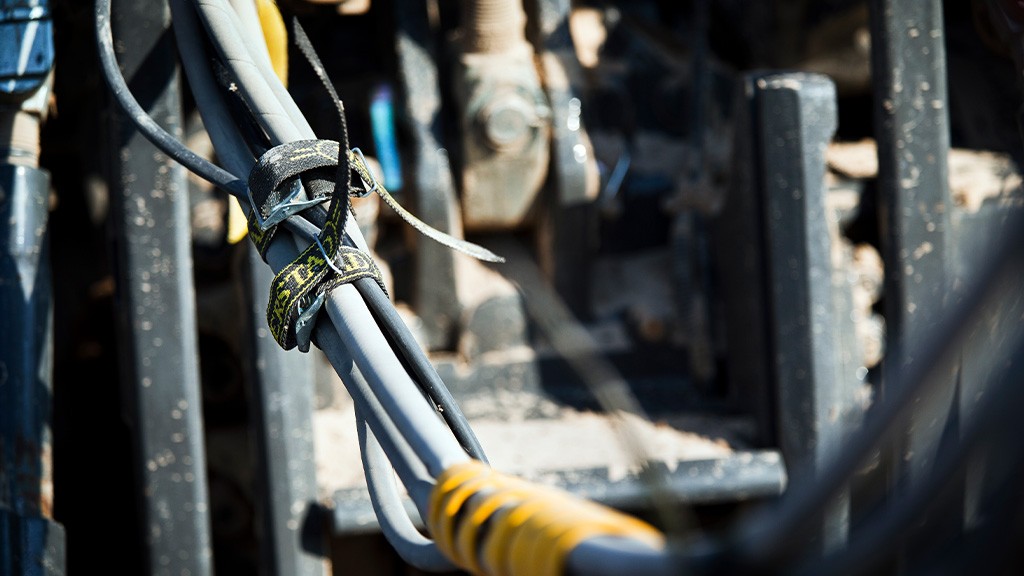
Hydraulic hoses are the most delicate components of construction equipment, and to stay organized on the machine — and off the ground — they are typically fastened using zip ties. This isn't news if you regularly service hydraulics, but if you're not directly maintaining or working with hydraulic lines, you probably haven't noticed, or considered, how many zip ties are used to manage them.
The downsides of zip ties
While they are cheap and easy to use, the ubiquitous zip tie has drawbacks. Zip ties have hard edges that can cut and cause unnecessary damage to hydraulic hoses. They are single-use and must be cut whenever hydraulic hoses are replaced or serviced. Install a hose wrong during servicing? Those new zip ties need to be cut and tossed away.
The zip tie's big advantage is its low cost per unit, with the smallest ties costing just a few cents. However, more robust, thicker zip ties are more expensive, and all of these zip ties take time to cut. Their low cost adds up.
Another solution is Velcro, but that also has drawbacks: Velcro isn't durable for extended use in harsh outdoor environments and can easily become clogged with mud.
Straps are a simple alternative to zip ties
An easier, more cost-efficient alternative to the zip tie or Velcro is a reusable strap that is specifically designed and manufactured to withstand rugged job sites and repeated use.
Swedish manufacturer Arno-Remmen AB has designed its reusable polypropylene strap with a self-locking buckle to be a more convenient alternative to zip ties. These straps are cost-effective, stronger, easier to use, and have softer edges, eliminating the risk of fastener-induced wear on hoses.
The company's first strap was invented to fasten skis in the 1940s, and the design was later applied to industrial applications. The current design was patented in the 1970s, and its buckle was updated in the 1990s. Today, Arno straps are made of 25 percent recycled material and are used by OEMs, service technicians, and dealers as a convenient, long-lasting method for securing hydraulic hoses on construction and mining equipment.
You might be familiar with Arno straps, even if you don't recognize the name — and that's for good reason, explains Patrik Svensson, Arno-Remmen's sales representative in Canada. These straps are often branded by the customer, such as an OEM or service provider, or they come in plain black, which has allowed the Arno-Remmen brand to fly under the radar.
Arno straps are a more common method for managing hydraulic hoses in Europe, and they are often referred to as "Copco straps," says Svensson, because of their extensive use on Epiroc (formerly Atlas Copco) equipment for underground mining. That OEM is a leading evangelist for this solution: in addition to fastening hydraulic hoses, the Epiroc-branded Arno straps fasten fire extinguishers, tools, and more.
According to Svensson, service techs who encounter the straps are enthusiastic about them, even if they don't know where they come from and aren't familiar with the Arno brand name. That enthusiasm is earned by the high-quality, reliable construction of both the strap and buckle and their ease of use.
Easy-to-use fasteners that are made to last
The Arno strap is made from high-grade polypropylene yarn woven into webbing on a Jacquard loom.
This high-grade material ensures the strap's longevity compared to similar straps constructed from lower-grade polypropylene, says Svensson. Straps made from lower-grade materials are more prone to wear, can become brittle, and can break, particularly with prolonged UV exposure. High-grade polypropylene yarn keeps the strap strong, potentially for decades of use.
While these straps are not sewn in a loop and thus are not designed (and should not be used) for lifting, an Arno strap has the strength to hold several hundred pounds, says Svensson, which is plenty robust for its applications.
Fastening and unfastening the strap is easy. Pressing on the end of the compact, alligator-mouth-style buckle will lift the fastening mechanism and allow you to slide the other end of the strap through. When the buckle is released, the strap loop will lock in against small teeth that do not rip into the webbing.
An additional loop can fasten the strap around a hose for convenient management of hoses that are regularly connected and disconnected, such as hydraulic attachment hoses. The strap can stay attached to the hose while the attachment is connected to the carrier machine, leaving the longer tail ready to secure the coiled line when it is disconnected. This easy solution keeps the hose off the ground and protects the fitting end.
The straps are available in 18 mm and 25 mm widths and lengths can range from 25 cm to 10 m. Hydraulic hoses are usually fastened with 25 mm width straps. The straps are available pre-made in solid black for small orders, but Svensson says that the bulk of Arno-Remmen's business in North America is fast-turnaround custom orders. Branding can be woven in on custom orders, with up to 3 colours for the 25 mm width. Typically this will be a black backing colour with two additional colours forming the custom design.
When a design is added to reinforce the customer's branding, the strap is literally made stronger. The Jacquard weaving method incorporates the branding pattern into the weave, which strengthens its structure. The branding does more than last. It makes an already durable, useful product even stronger.
Bulk orders for custom-branded straps require a minimum 300 metres total length of webbing; that total length can then be divided into a variety of strap lengths. Bulk custom orders for Canadian customers can be fulfilled within four weeks, including shipping time, and the brand does almost all manufacturing in Sweden.
Straps can protect assets
Hydraulic hoses are the most vulnerable components on construction and mining equipment, and caring for them properly can reduce downtime and maintenance costs. While fasteners may fill a rarely considered function on complex machines, they are vital to effective hydraulic hose management. A switch to straps can also help protect the equipment by eliminating unnecessary wear from tightening zip ties with sharp edges.
That durability and longevity of the Arno strap keeps customers coming back, says Svensson, "You have a solution that is cost-effective, much stronger, and easy to use, and that's where it really excels."
The custom branding builds on these benefits, he concludes. "When the machine owner sees the branded strap on their hydraulic lines, they know who to call for service."
This article originally appeared in the May/June 2026 issue of Heavy Equipment Guide.