
VIDEO: North America’s biggest demolition excavator
The transformation of BCS Enterprises’ Cat 5130B UHD from mining excavator to demolition behemoth
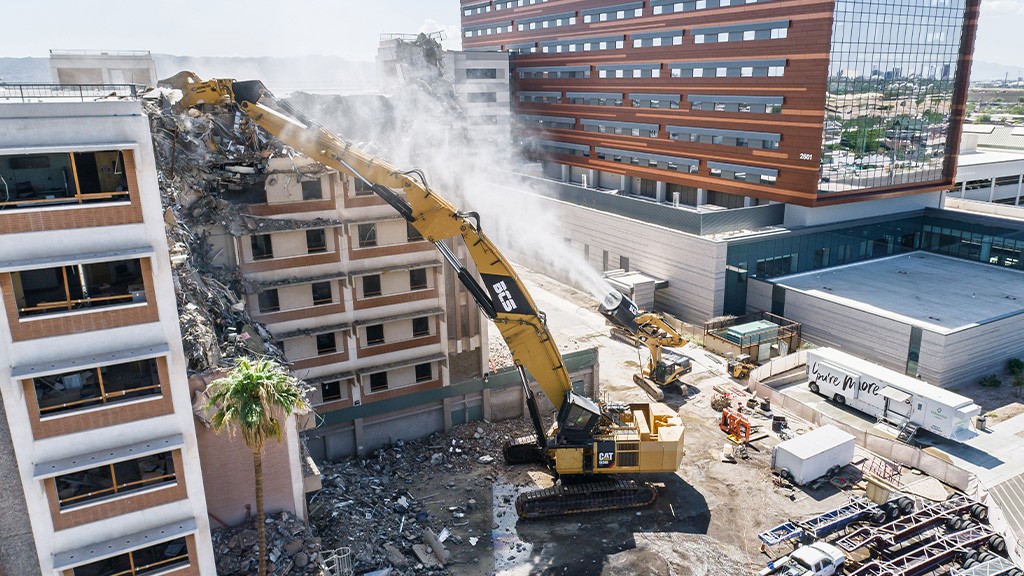
A mining excavator doesn't usually go to work on an urban job site, but BCS Enterprises' Cat 5130B UHD is an impressive exception. Cat doesn't offer a 5130B ultra-high demolition excavator. Instead, over the course of multiple owners, two transatlantic journeys, and a couple of decades, a Cat 5130B mining excavator has been converted into North America's biggest demolition machine.
Since 1956, BCS Enterprises has been helping clients safely and effectively demolish old infrastructure throughout the American Southwest. BCS specializes in selective and structural demolition, with key projects including a large power plant in Tucson, Phoenix Trotting Park, and a 200-foot-tall smelter stack in Dewey-Humboldt. Today, BCS Enterprises is one of the leading demolition companies in Arizona with headquarters, laydown yard, and shop facilities located in Mesa.
Demolition has always been about more than simply smashing and wrecking buildings in an unorganized manner: it's a coordinated effort between engineering, heavy equipment, and operators to carefully remove outdated infrastructure. I had the opportunity to see BCS' Cat 5130B UHD on its latest project, the demolition of a Valleywise Medical Health Center building in central Phoenix, where it was integral to that coordinated demolition effort — but the 5130B UHD's vital contribution was only possible because of its unusual journey.
High-reach, heavy-duty demolition requires a unique solution
America's biggest demolition machine is well-travelled — and has been extensively modified — having worked in multiple countries before finally landing in Arizona with BCS Enterprises.
BCS Enterprises' Cat 5130B UHD began its journey as a conventional Cat 5130B mining excavator in backhoe configuration. Caterpillar originally unveiled the 5130 series machine at MINExpo 1992 as a prototype, with the B series debuting in 1997. When released, the 5130B excavator weighed 200 U.S. tons (400,000 pounds) and was powered by a Cat 3508B diesel engine producing 860 hp. It was fitted with a 13.7-cubic-yard bucket and built to pass-match a 100-ton mining truck, such as the Cat 777.
This Cat 5130B was originally sold by Thompson Tractor Company in June 2002 to an open-pit coal mine in Birmingham, Alabama, where it was used to strip overburden. Once the machine was no longer needed at the mine, it was sold to Euro Machinery, a heavy equipment trading company, and then sold and shipped to Rusch, a specialty crane repair and inspection company based in the Netherlands, in 2008.
Rusch had been contracted by Norway-based AF Offshore Decom to build a high-reach machine for demolition of offshore oil rigs from the North Sea. Once decommissioned, these large, heavy-duty platforms were floated to the AF Environmental Base to be brought onshore one by one for dismantling and recycling. AF Offshore Decom identified that cutting the platforms into pieces with shears would be the fastest option. However, it was clear that the cutting had to be done at height, and given the heavy-duty construction of the structure with 915-mm-diameter steel pipes, the only suitable tool was a 25-tonne shear, which would require a specialty carrier.
A big transformation
Rusch refurbished and then converted the Cat 5130B mining excavator into a specialty high-reach demolition machine that fit AF Offshore Decom's demanding application.
While still resembling the mining excavator at the base, Rusch built it into what it called a RS7500 in triple 34-25 configuration. The 34 refers to height in metres that the machine can reach, while 25 refers to weight in metric tonnes of the work tool that the machine can handle at that maximum reach.
Construction of the new boom relied on Rusch's extensive expertise in crane repair and service. Cranes feature high-tensile steel in their boom construction, allowing for the boom to be lighter, bigger, and stronger. The high-tensile-steel boom that Rusch built for the excavator is four times stronger than rebar, measuring 960 newtons per sq mm. The steel can only be sourced from two suppliers in Europe: SSAB in Sweden and Thies in Germany. It is heat-treated with metallurgy incorporating chrome, nickel, copper, and vanadium for strength. The modular triple 34-25 boom consists of three pieces: a 17-m-long boom, 4-m-long mid stick, and 12-m-long stick.
The machine's base was also modified to increase stability. In addition to moving the OEM counterweight farther back to balance the machine, the track frames were lengthened and the undercarriage was widened to make a 10-m-long by 10-m-wide footprint, giving the machine a square base to work from.
The three main boom cylinders were built in-house by Rusch for longer stroke and to accommodate torsional forces, while the OEM Cat 5130B boom and stick cylinders were moved up to the mid stick and stick.
A mining excavator requires hydraulic pump priority for slewing (swinging) circuits, so Rusch redirected the hydraulic pumps to prioritize work tool, boom, and stick functions for demolition.
Rusch modified the cab to tilt 40 degrees to give the operator better visibility up to their work area. The cab was also outfitted with bulletproof glass and metal cage guarding to protect the operator from debris.
In addition to the expanded undercarriage footprint and repositioned counterweight, Rusch added a safety system that prevents tipover if the boom is vertically extended too far. Sensors measuring angles and position of each of the three boom sections, in addition to pressure sensors in the hydraulic cylinders, all feed data into a programmable logic controller (PLC), which can warn and then cut boom movement if it exceeds a pre-determined safe working limit. The completed machine was named Big Wolf and shipped to AF Offshore Decom in 2009.
Big Wolf on the move
Once AF Offshore Decom's oil rig dismantling project was complete, the specialty machine's fate was uncertain. It was put up for sale, but it was unclear when, or even if, a buyer would appear. In 2017, it caught the attention of Arizona-based BCS Enterprises. BCS acquired and shipped it back to Phoenix — the well-travelled, and transformed, Cat 5130B returned to the U.S.
Before putting it to work, BCS Enterprises made further modifications to better-suit their application. BCS added 100,000 pounds of additional counterweight, moved the counterweight farther back, and widened the carbody by 25 inches to better balance the machine. The machine was repainted with custom trade dress, and BCS decals were applied. While the original Cat 5130B trade dress was from Caterpillar's "red line" era, BCS applied a much more visually appealing "power edge" trade dress with an outlined "UHD" designation, denoting the new ultra-high-demolition configuration of the machine.
To make transportation easier, a cable winch system for counterweight removal was added along with four hydraulic jacks mounted to the undercarriage to allow for easier removal of track frames. Transporting the machine takes 12 semi-truck loads split into key components, which include mid stick and stick, work tool, diesel power pack, track frames, counterweight, carbody, super structure, and two boom sections. Assembly or disassembly of the entire machine typically takes BCS roughly one week if everything goes smoothly.
In the cab, BCS added a seven-point 4K resolution camera system to allow for better visibility around the machine. The live camera stream also connects to a spotter's iPad for added safety.
With a deep understanding of its market and future projects, BCS focused on building different reach configurations. In its base configuration, the Cat 5130B UHD can reach 120 feet to the top pin. BCS built a 40-foot boom extension for the machine, which reaches 150 feet to the top pin, and, if that still isn't enough reach, BCS also has a custom 40-foot hook attachment, which allows the machine to reach 200 feet. In both the 120- and 150-foot configurations the machine hosts a Genesis GXP2500R scrap shear that weighs 25 tonnes and can cut 46-inch steel I-beams. The culmination of Rusch and BCS Enterprises' extensive modifications is a 400-U.S.-ton beast — that's double the original Cat 5130B mining excavator's operating weight.
A massive solution for urban demolition
There are few machines comparable to BCS' Cat 5130B UHD, and, while it sometimes sits idle in the contractor's Mesa yard, BCS isn't afraid to deploy it in any of its three high-reach configurations.
In fall 2025, I got to witness the 5130B UHD come out of hibernation to demolish a 120-foot-tall, nine-storey building at Valleywise Health Medical Center in central Phoenix. The machine was outfitted with a 20,000-pound Genesis GDT 890 concrete pulverizer and made quick work of the building by pulling, toppling, and chewing into the concrete structure, while smaller support equipment, including Cat 385C and 395 excavators, sorted and removed the material for recycling.
It's no secret that demolition creates a lot of dust. Given the location of these projects in urban centres, BCS developed its own dust suppression solution for the massive machine. The BCS Rainmaker is a custom-built water cannon consisting of an array of spray nozzles and a hydraulically powered fan. Resembling a jet engine and fixed to the end of a Cat 330 excavator, each Rainmaker lays down a monsoon-like mist to suppress any dust created by the Cat 5130B UHD.
After completing another successful project, BCS' Cat 5130B UHD was demobilized and returned to the yard in Mesa. There it quietly waits for its next big demolition assignment.
Mack Plovie is the president and chief dirt enthusiast of Earthmovers Media.
Thank you to BCS Enterprises, Rusch, and AF Offshore Decom for providing the account of the Cat 5130B UHD's transformation from mining excavator to America's biggest demolition machine. See more of BCS Enterprises' Cat 5130B UHD in action on their Instagram.
This article originally appeared in the May/June 2026 issue of Heavy Equipment Guide.