
Although it’s a venue devoted to leisure, a golf course is one place where the work never seems to stop. Those in the industry know course-related maintenance and renovation are a year-round business. From installing irrigation or drainage systems to planting trees, preparing flower beds or building fences – and everything in between – there are always tasks to do on a golf course.
Golf course projects are different from other maintenance tasks because much of the work needs to be done when the course is open for play or other events – so efficiency is everything. Course maintenance crews already have vast equipment fleets, including skid steers, utility tractors, backhoe loaders, chippers, grinders and mini excavators, to help with their ongoing landscaping and hardscaping work. They need equipment that not only maintains the turf but also influences the play, and maintains the appearance of the course. However, much of this machinery is fairly large and heavy, limiting when and where crews are able to operate.
Working without a handicap
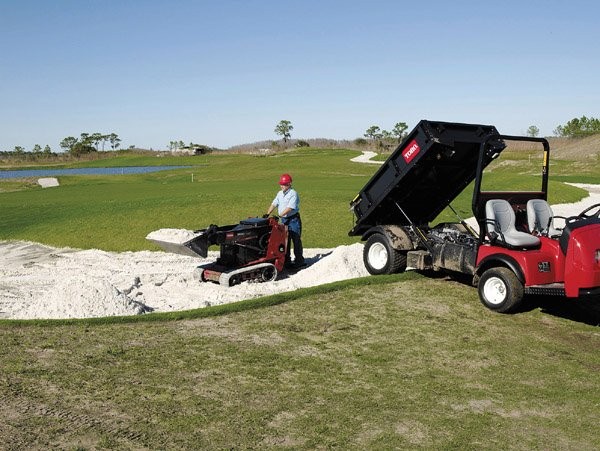
These days, many superintendents are adding compact utility loaders to their maintenance fleets. Preferred for their compact size and narrow profile, compact utility loaders easily operate in confined areas, around existing landscaping, and through space-restrictive areas like gates. They also work well on delicate ground conditions, like greens and bunkers, because of their light footprint – as low as 3.4 psi on some models.
Dave Tooley is superintendent of the four South Suburban Golf Courses in Centennial, Colorado and has been using a Toro Dingo TX425 compact loader for about three years. Tooley says he was intrigued by the loader when his dealer, LL Johnson in Denver, first showed it to him. To Tooley, the loader seemed like the right tool for small jobs around his courses. “Compact loaders are great for golf course work,” he explains. “They are small and lightweight, and with the wide tracks, my crews can drive on the course without tearing up the turf. And, these loaders are designed with everything out in front, which allows my operators to see where, and how, the machine is working.”
Tooley and his crews often use their loader to clean out and renovate bunkers, as well as cut new drain lines, plant trees, haul bark and prepare soil for planting. They use the loader in the winter months with a snow blower attachment to clear walkways and areas around an inflatable dome used for sporting events.
“Versatility is the compact utility loader’s biggest asset to us on the golf course,” concludes Tooley. Superintendent at the Kanawha Club in Manakin Sabot, Virginia, Paul Van Buren also likes the loader’s ability to handle tough tasks on his course.
“About four years ago, we rented a Toro Dingo with an auger attachment to put a fence in on the course,” he says. “The fence was a mile long, and we needed centre posts every eight feet.” Van Buren was so impressed with the machine’s performance, he eventually bought it. The flotation and the footprint of the loader are also important, says Van Buren, who was amazed at how gentle the machine is on the turf. Van Buren’s 35-acre private course is open from April to December and does not have cart paths, so the loader is expected to operate in all kinds of weather and on many types of ground conditions, including plowing snow on hard surfaces and maneuvering on wet grass.
“I haven’t found another machine of its size that can do what my compact loader can do. We use our loader every day to move plants, rock and mulch around the course, as well as other tools and materials around the shop,” explains Van Buren. “We have a five-year landscaping plan, and each year, we have 150 to 200 plants that need to be planted. These plants come on three tractor trailer loads and need to be planted within two days. Because it isn’t practical to bring in a larger tractor for these two days, we use our Dingo to get the job done quickly.”
Par for the course
What makes a loader most valuable to course maintenance crews, though, is its versatility. When paired with the right attachments, one compact utility loader can easily turn into a multipurpose tool, allowing grounds crews to complete more tasks in less time, and with less effort.
“We were using a dedicated trencher before on drainage projects,” says Pete Wendt, superintendent of the Kinloch Golf Club, also in Manakin Sabot, Virginia. “But we decided to replace it with a more multipurpose tool that we could use year-round. A compact utility loader fits a niche need on our course, and we can do a million things with it.”
Wendt chose a larger compact loader – a Toro Dingo TX525 diesel unit – because his crews needed to power through heavy clay soils. He also chose the tracked model because it was less intrusive on the course’s fine turf areas.
Using a variety of attachments, including a trencher, bucket, auger, forks and soil cultivator, Wendt says his compact utility loader occupies a space that no other type of equipment on the market can compete with.
Jake Gargasz, another superintendent, at Muirfield Village in Columbus, Ohio, says the Dingo’s uses on his course have been virtually limitless, and include constructing bunkers, trenching for irrigation and drainage, hauling gravel – even installing phone lines before tournaments. “The multiple attachments make it more attractive to rent than any single-task machine.
Jeff Holliday, superintendent of The Salisbury Country Club in Midlothian, Virginia, has had a Toro Dingo TX 425 for four years,
“I have six crew members trained on the loader, and we use it year-round,” says Holliday. “With the trencher attachment, we do a lot of drainage work in the winter months. We also use it with an auger attachment to plant small trees and dig post holes for new fences. We use the soil cultivator attachment to prepare beds for seeds, and we haul mulch and sand with the bucket attachment.”
Holliday uses the stump grinder attachment to clear out small trees, and relies on the cement bowl attachment for small patch work and hardscaping projects around the course.
Whatever the task on the golf course, it goes to show that there are few jobs that a compact utility loader can’t handle.