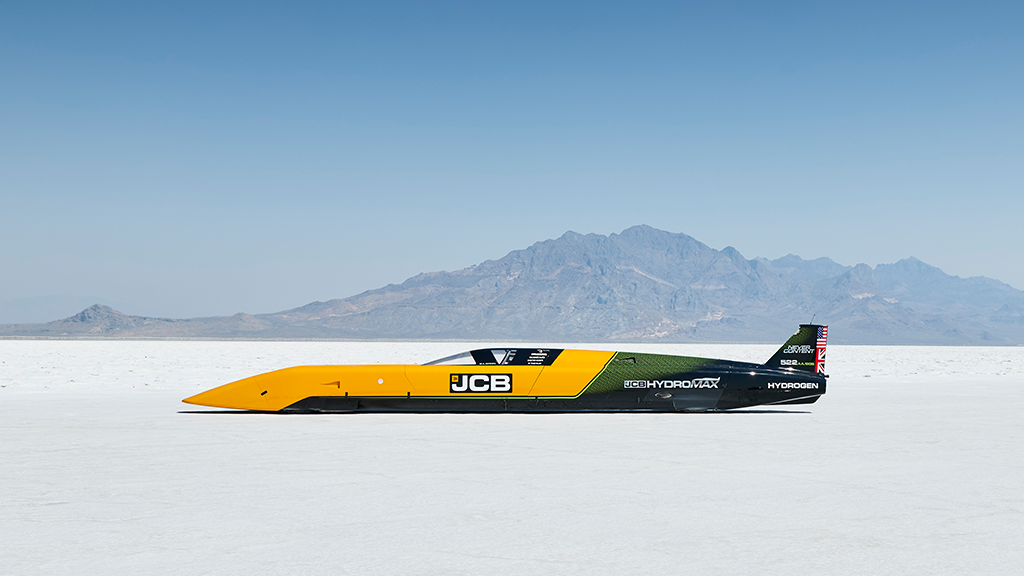

JCB sets world hydrogen land speed record using construction equipment engines
The JCB Hydromax reached 402.320 mph on the Bonneville Salt Flats in Utah

On the morning of August 11, on the barren Bonneville Salt Flats in Utah, engines developed for construction equipment were put to a rare test — a speed record. Two JCB hydrogen combustion engines powering the 32-foot JCB Hydromax car produced a combined 1,600 bhp (brake horsepower) to set an astonishing world hydrogen land speed record of 406.320 mph on the Bonneville Speedway.
Piloted by Wing Commander Andy Green OBE, the Hydromax speed record of 406.320 mph is substantially faster than Green's own JCB Dieselmax world diesel land speed record of 350.092 mph that was set on the same track in 2006. The record was validated by the FIA (Fédération Internationale de l'Automobile), the governing body for world motor sport. The previous hydrogen internal combustion record was 185.5 mph, set by the BMW H2R in 2004, and the previous hydrogen fuel cell land speed record was 303 mph.
JCB Chairman Anthony Bamford was in Bonneville to witness the record.
"Twenty years ago we came to Bonneville with JCB Dieselmax and showed what British engineering could do with diesel power. Today we have done it again — this time with engines powered by hydrogen. This record was set by production-based engines, the same engines powering JCB diggers right now," said Lord Bamford. "That is the point of JCB Hydromax: it shows hydrogen works, and it works today at the highest level with zero emissions."
What contractors should understand about the JCB Hydromax
The Dieselmax project in 2006 was designed to demonstrate JCB's engineering capability to the world, and the Hydromax continues in that tradition. But this time a record was set using a combustion solution that's less commonly understood and far less validated in the field.
The engine model powering the Hydromax is currently used in JCB's 3CX Hydrogen backhoe loader, which is now available in Europe. JCB says that the hydrogen-powered backhoe loader, operating on a typical duty cycle, could reduce CO2 emissions by around 9,000 tonnes annually. Unlike battery-electric equipment, the 3CX Hydrogen does not require a grid connection to recharge. Instead, the refuelling process is similar to diesel machines.
After the record-setting run, JCB North America President and CEO Richard Fox-Marrs and JCB Engineering Director Ryan Ballard were excited to discuss the Hydromax project's implications for hydrogen-powered construction equipment.
"We're very passionate that hydrogen fuel has a place with internal combustion engines. We're absolutely convinced as a business that the internal combustion engine has got a long future . . . There's a supply chain, the technology is understood. So [the Hydromax is] all about showcasing how hydrogen fuel can combine and just create a broader educational piece of what is truly achievable for the future," said Fox-Marrs.
Fox-Marrs hopes that the Hydromax record demonstrates JCB's value as a partner to contractors. "We are a very forward-looking, very futuristic company that has engineering prowess that we're very, very proud of and someone they should see as a reliable partner moving forward."
Ballard, who served as project leader for the Hydromax, will apply learnings from the project to JCB's construction equipment.
"We've taken cutting-edge motorsport technology, and now we can go, well, how can we apply that to our machines?" Ballard said. "We've learned a lot on this car project, not just about hydrogen and the engines, but we've also learned about how to control them. We've got a lot of real-time monitoring of systems and [how] the system responds to temperatures, pressures, etc. . . . Now I think that has got some great potential on our construction kit."
Construction equipment has to work 24/7 and be continuously reliable on job sites, Ballard continued. "If we can have enhanced telemetry, enhanced on-board monitoring, it's looking for how to optimize that machine all the time. It can give better uptime. It can give better fuel economy, increased performance. It's things like that that we'll take away from this."
JCB's hydrogen combustion strategy for construction equipment
In 2025, JCB received approval in Europe for mobile generators and the 3CX Hydrogen backhoe loader; the company is gauging the reaction to that equipment in European markets while undergoing the approval process in the U.S. In North America, hydrogen fuel infrastructure is a significant hurdle to hydrogen combustion engine commercialization, and that fuel infrastructure is needed before hydrogen combustion machines can become cost-competitive for customers.
For some, the interest is already there, Fox-Marrs said. "We have a significant number of customers who are more than interested in the concept and are pushing us to bring machines into the market. Undoubtedly, they'll be the pioneers. And, as any new introduction into the market goes, we'll have those early adopters and then we'll see and we'll go from there."
Meanwhile, the record set in Bonneville further supports hydrogen combustion viability for construction equipment.
"Clearly the powertrain in the Hydromax is working at levels way and beyond anything that you would see in a routine construction application. But I think there's significant learning that's come from that as an organization that we will apply to commercial products going down the line. The learnings that the team have had have been immense and just gives us another further advantage as we start to deploy that technology to our commercial customers," said Fox-Marrs.
As for when those machines will become widely available to the construction industry, it's hard to say, but Fox-Marrs is optimistic about the technology's progress and early adoption.
"Five years from now, I do see the technology beyond the early adopter phase for certain. I see it anywhere we have a JCB engine in a product . . . We're excited to see how the infrastructure allows that to happen going forward."
This article originally appeared in the October 2026 issue of Heavy Equipment Guide.