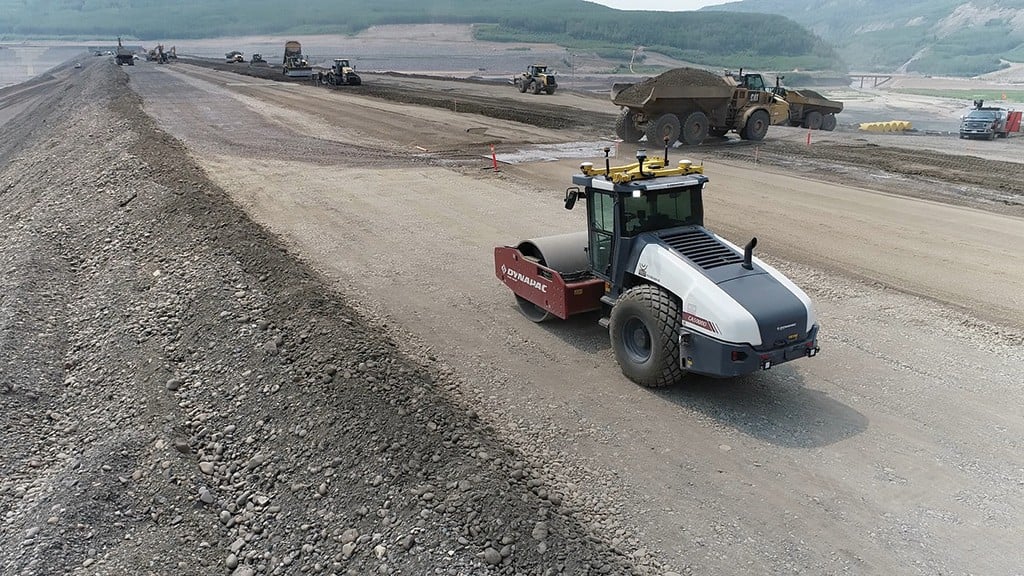

Accessible autonomy solution expands the role of the operator
Autonomous retrofit kits for rollers and ADTs free up operators for more critical tasks
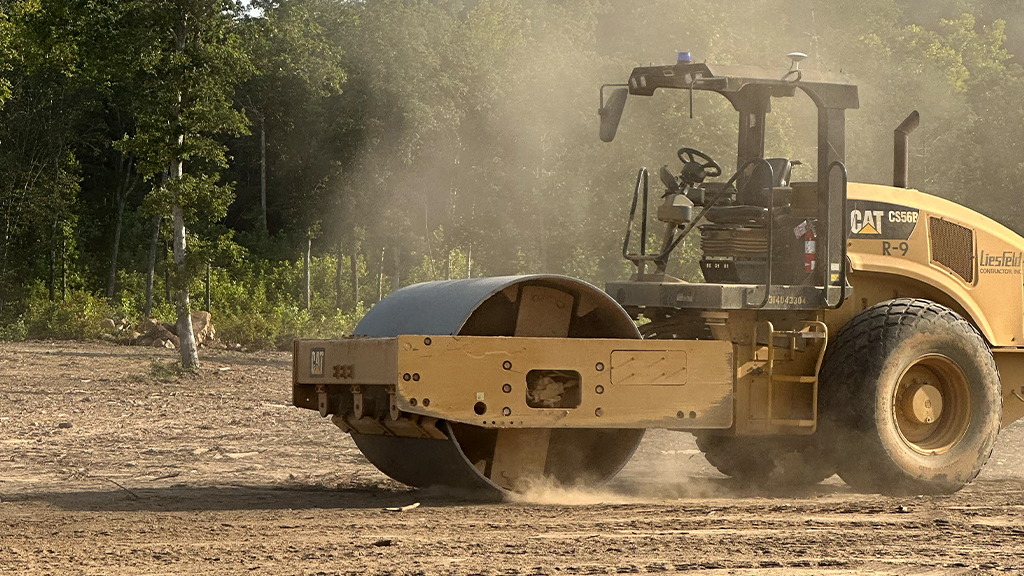
When labour is tight, contractors want their operators on the most critical tasks, but lower-skill work, such as soil compaction, still needs to be done. Autonomy is a potential solution to this problem.
There is a perception that autonomy is complex and expensive to integrate into a fleet, particularly for smaller contractors. Bluelight Machines is lowering the barrier to autonomy with its autonomous retrofit kits, which allow contractors to easily and safely incorporate autonomy into their operations by converting the machines they already own.
Smooth drum and padfoot rollers outfitted with the retrofit kits are now operating across North America, South America, Australia, and Asia. Applications include solar farms, DOT highway projects, mining operations, data centres, large-scale earthworks, and residential developments. Kits are compatible with select Dynapac, Cat, and Hamm rollers, and Bluelight has also introduced the technology for select Volvo and Cat articulated dump trucks.
Safe, easy-to-integrate autonomy keeps learning from real-world data
Retrofit is quick — less than half a day — and, once the kit is installed and the Bluelight annual subscription is activated, managing the machine is simple via a smartphone, tablet, or desktop. Kits can easily be transferred between supported rollers and ADTs.
Bluelight is a camera-based detection system that does not use Lidar, which bounces off dust particles, says Dick Zhang, CEO. The autonomous system is trained on hundreds of thousands of pictures using AI pattern recognition, also known as machine learning; however, it's not good enough to just feed the system pictures of the same dozer, says Zhang. The training material needs variety in equipment sizes, brands, configurations, and colours, as well as times of day and environments.
Hundreds of Bluelight machines are now operating autonomously in the field, and, as those machines gather more data, they make the system smarter and more productive for all Bluelight users.
Since Bluelight machines are operating on multiple continents, that growing repository of training material is increasingly diverse, capturing different equipment, job site types, and conditions. Zhang says that new data is trained on a GPU then put on a customer beta test fleet. It is fine-tuned over the first hundred to thousand hours before an update is made available over-the-air to all Bluelight-connected machines.
Autonomy expands the role of the operator
There is a common misconception that autonomy replaces skilled operators.
"People think of autonomy, and they've got this vision of, wow, [the job site is] going to be this ghost town," says Zhang. "That could not be more wrong."
Instead, autonomous machines facilitate the redistribution of labour to where it provides the most value, and it expands the skill sets of operators. Experienced operators are freed up to do more complex work, extend their expertise by supervising multiple autonomous machines, or operate a lead piece of equipment while supervising a buddy machine.
For example, a Bluelight-equipped autonomous roller is frequently buddied up with an operator in a dozer. The dozer operator can knock down fill while the roller follows behind to perform the compaction.
Bluelight-equipped rollers also carry out independent, autonomous work, such as compaction of a large area, while overseen by a supervisor.
Programming the workflow is simple. Through the Bluelight web portal, the supervisor can connect to the machine remotely, draw the work boundary for compaction, set the overlap and number of passes, and upload the job to the roller. Avoid zones within the work perimeter can also be added. Once the roller is lined up with the start point of the job, initiating autonomous compaction is as simple as dragging a slider on the web portal. The roller proceeds to complete the assigned work without additional intervention.
A work boundary can also be set by either remotely or manually driving the roller around the perimeter of the intended compaction area. Everything within that zone can then be compacted autonomously. A supervisor can also create a work boundary by walking or driving the perimeter of the area with their smartphone. Because smartphone GPS is less accurate than the machine, the track will not be as precise and can have a margin of error of several feet.
The system works in conjunction with compaction technologies, such as Dynapac Seismic and the Trimble ecosystem.
Bluelight's autonomous compaction milestone demonstrates real-world effectiveness and safety
At CONEXPO-CON/AGG 2026, Bluelight announced that retrofitted rollers have completed 1 billion square feet of autonomous compaction without a single job site injury, logging more than 300,000 object detections and 60,000 autonomous safety stops. The company says that the system has identified and halted for personnel, trucks, heavy equipment, traffic cones, and grade stakes.
"It's proof that autonomous construction is no longer a concept being tested in controlled environments," says Zhang. "Our customers are running production sites every day with Bluelight systems detecting hazards, stopping for workers, and multiplying what a single operator can accomplish."
Zhang acknowledges that shifting to autonomy can be hard for some operators.
"A number of times we've just installed the auto roller, we've taken the guy out of the seat, and then they see the thing rolling without anybody in the seat . . . it's an emotional, passionate reaction," Zhang says. "But when you think about operating construction equipment, and you hear the numbers . . . we only ever have fewer and fewer people."
Autonomy is not removing skilled operators from the job site; instead, it is evolving the role of the operator. Zhang concludes, "They show up, and they want to produce for their team. We are enabling them to do more."
This article originally appeared in the September 2026 issue of Heavy Equipment Guide.