
New approach to urban pothole repair triples patch rate while streamlining logistics
All Roads Construction uses Canada’s first JCB Pothole Pro to tackle Vancouver’s ambitious patching program
In a city struggling to keep up with infrastructure repairs, one construction company found a smarter way forward. All Roads Construction, a British Columbia-based civil contracting firm known for its progressive approach and rapid growth, has successfully delivered on year one of Vancouver's ambitious patching program and is heading into the 2026 paving season with renewed vigour, tackling the remaining backlog with a level of precision, pace, and ingenuity that's turning heads across the industry.
By pairing their in-house culture of innovation with a pioneering deployment of new technology, All Roads has rewritten the rules on how roadwork gets done.
All Roads Construction is driven by innovation
Founded just eight years ago, All Roads Construction has grown rapidly from a two-man venture to an $85 million operation with 150 employees. For Denis Labelle, vice president of operations, the formula is simple: empower people, pursue efficiency, and never stop evolving.
"We love being the first to try something new," Labelle says. "Not just for the sake of it but because it gives us an edge — in quality, in productivity, in attracting top talent."
That approach has yielded impressive results. All Roads was the first Canadian contractor to implement Topcon SmoothRide, a data-driven paving solution for highways. They were early adopters of total robotic stations and millimetre-accurate GPS systems. Today, the company routinely takes on large-scale municipal and highway projects, delivering consistent quality with fewer delays and less disruption.
This commitment to innovation and willingness to rethink conventional methods made All Roads the ideal partner for a project that demanded not just experience, but ingenuity — especially in navigating the scale and complexity of Vancouver's patching backlog.
An unprecedented urban patch program
The city's utility patch backlog wasn't just large, it was historic. Some work orders dated back to 2008, a 15-year accumulation of unaddressed road repairs following utility tie-ins from various developments. The scope and age of the backlog were so extensive that the city created a five-year patching program, with the year-one contract covering 1,800 patches. Projected annual value was $5.4 million.
All Roads Construction secured the initial 2025 contract with the understanding that they could become the long-term partner if they delivered results.
But this wasn't typical resurfacing work. The patches were scattered across Vancouver's most densely populated neighborhoods, with work zones squeezed between parked cars, bike lanes, and narrow rights of way. Each site required a full workup: pre-marking, no-parking signage, photographic documentation, and traffic coordination. Every patch had a unique work order number that had to be tracked and documented independently.
"The scale of the paperwork alone was intense," Labelle says. "But the real challenge was logistics. How do you bring in a fleet of equipment when you've got no space to operate?"
The city's initial expectations reflected a conventional approach. They envisioned using two paving teams, each with a half-metre milling machine that would require a full-size lowbed for transport and take up nearly a full lane width on site. In a typical set-up, the dual crews would also need a skid steer for cleanup, an excavator to remove concrete patches, and a separate sweeper to finish the job.
To accommodate all of that, All Roads estimated they would need to cordon off an entire city block, sometimes even two, just to fit equipment and staging areas. This was an unrealistic demand in a city with tight curbs and minimal off-street parking. Even then, work could be delayed by vehicles parked illegally despite posted signage.
And the patches weren't clustered. "This isn't linear highway work," Labelle says. "You might do three patches on one block, then move five blocks away to do one more. Multiply that by 30 active job sites a day, and you begin to see the scale."
The city's towing policy added further complexity. If a vehicle remained in the zone after signage was posted, the crew had to skip the patch and return the next day. If the vehicle was still present on the second attempt, only then could a tow be requested — adding days to the process.
"If we used the city's model, we'd be stuck waiting, moving, and coordinating more than we'd be patching," Labelle says. "And every move costs money, especially when you've got to load and unload a milling machine on a lowbed just to go five blocks."
That operational burden prompted All Roads to rethink the entire approach. Rather than scale up crews and equipment, they aimed to scale down in size, footprint, and complexity. The solution came in the form of a machine that didn't exist in the local market yet.
Enter the JCB Pothole Pro
While discussing the purchase of an additional skid steer with All Roads' JCB dealer, Labelle was introduced to a machine that wasn't even available in Canada at the time: the JCB Pothole Pro.
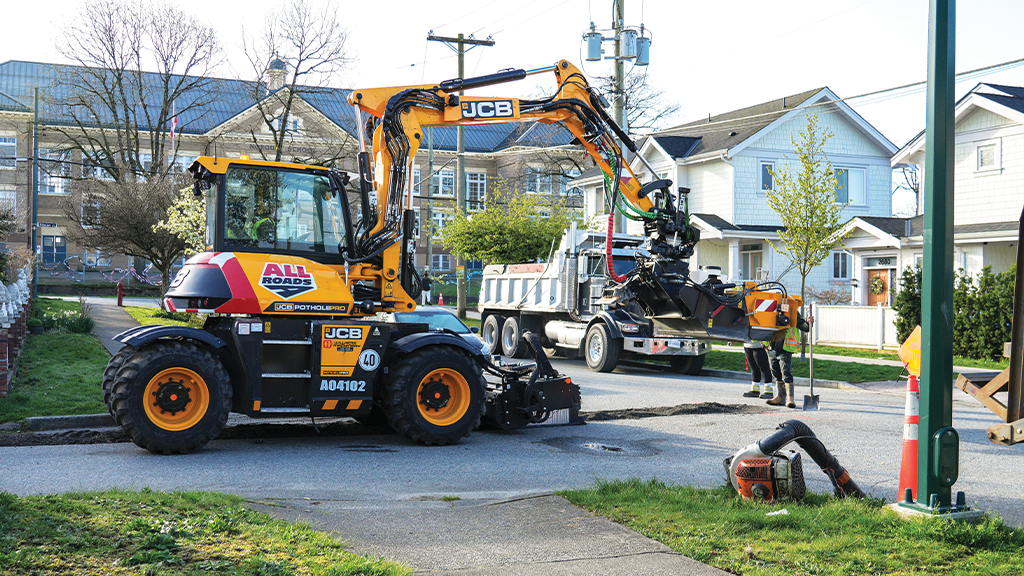
The Pothole Pro is a fully integrated, self-contained road repair unit designed specifically for urban patching. At a glance, it resembles a compact wheeled excavator, but instead of a bucket, a 47.2-inch-wide (1.2-metre) planer is mounted on a hydraulic arm. The planer is capable of milling up to 6.7 inches (170 millimetres) deep in a single pass. Behind that sits a 23.6-inch (600-millimetre) cropping tool that precisely squares patch edges — eliminating the need for separate saws or cutters.
At the rear, a rotary broom and integrated debris collection system allow operators to sweep up material immediately after milling. A 16-gallon (60-litre) collection bin holds the reclaimed asphalt, making cleanup a seamless part of the workflow. This innovative set-up allows crews to repair a pothole in under 8 minutes, according to the company.
What truly sets the Pothole Pro apart is its mobility. With a top speed of 25 mph (40 km/h), it doesn't require a trailer for transport. It simply drives from one patch to the next, even across neighbourhoods. That feature alone saved All Roads an estimated $1,000 per day in mobilization costs.
"Everything about the machine is purpose-built to reduce disruption," Labelle says. "It mills, it cleans, it drives. It doesn't need a separate crew to square up edges or sweep behind. It just gets it done."
Because of its compact size, the Pothole Pro can operate on tight residential streets without requiring full-lane closures or sprawling job zones. Crews even park the machine overnight at the next day's starting point, which eliminates morning mobilizations and improves daily output.
New pothole patching solution is a model of efficiency
In just two months, All Roads Construction transformed what could have been a logistical nightmare into a case study in urban infrastructure efficiency. By averaging 14 completed patches per day, the team has more than tripled the City of Vancouver's own production rate. That output hasn't come from working harder, it's come from working smarter with streamlined logistics, minimal mobilization, and a drastically reduced job site footprint.
The results speak for themselves. All Roads completed its concrete works ahead of schedule and was able to begin portions of its 2026 concrete program in the fall of 2025. Progress across the broader program has remained strong despite weather constraints and shifting project priorities, with overall performance leaving a lasting impression. The City subsequently awarded All Roads the 2026 patching contract, valued at more than $5.4 million.
To meet growing demand, the company ramped up its paving operations, adding a second patching crew to support completion of the remaining work and the newly awarded 2026 contract.
Throughout, the JCB Pothole Pro has played a vital role by minimizing downtime, simplifying operations, and enabling the kind of flexibility urban jobs demand.
For Labelle, the real success story lies not in the machine but in the mindset behind its adoption.
"In this industry there are still a lot of people doing things the old way because that's what they're used to," he says. "But the moment you stop being afraid of change, the possibilities open up. That's when you start pulling ahead."
All Roads has built a team that doesn't just accept innovation, they expect it. From in-house surveyors to autonomous paving pilots, the company continues to invest in tools and people that multiply their productivity. And for projects like Vancouver's, where complexity meets volume, that philosophy is essential.
"We don't buy tools," says Labelle. "We buy productivity. And the return we've seen on that approach? It's undeniable."
As Vancouver's patching program moves forward, All Roads Construction isn't just filling potholes. They're setting a new benchmark for how municipal work can — and should — be done.
Arielle Windham is a writer for the construction and demolition industry.
This article originally appeared in the July/August 2026 issue of Heavy Equipment Guide.