
Why machine control is an operational necessity for complex earthworks
Centimetre accuracy drives value in a tight-margin industry
Tight margins. Short timelines. A skilled labour shortage. The margin of error on a construction site has never been slimmer. Enter 3D machine control technology, which is redefining earthmoving and infrastructure building. By integrating Global Navigation Satellite Systems (GNSS) and 3D modelling directly into heavy equipment, machine control does more than just guide the blade or bucket; it digitizes the job site, turning heavy iron into precision instruments.
"The construction landscape has changed dramatically, and the companies that thrive will be the ones that leverage technology to work smarter," says Dan Hendriks, vice-president of sales — positioning technology at Brandt. "Machine control isn't just about making existing processes more accurate — it's about fundamentally changing how projects are executed. When you can eliminate guesswork, reduce material waste, and empower your operators with real-time precision, you're not just improving efficiency. You're future-proofing your business."
Two early adopters of the technology are Metric Contracting Services Corporation in the Greater Toronto Area, Ontario, and Weinrich Contracting Limited (WCL) in Edmonton, Alberta. For both, 3D machine control has evolved from a competitive edge to an operational necessity that delivers measurable improvements in accuracy, efficiency, and profitability.
Early adoption gives contractors a competitive edge
Metric is a family-run heavy civil contractor that has grown from a small earthmoving operation into a regional leader in excavation, site servicing, and infrastructure work. They focus on large-scale projects including transit, roadwork, and complex earthworks.
"Our philosophy has always been to evolve with the industry, especially when it comes to technology. We invest heavily in equipment, people, and innovation because efficiency and accuracy are critical in today's construction environment," says Richard Liorti, operations manager.
The company has more than 20 machines equipped with machine control, along with numerous handheld devices, base stations, rovers, and supporting technology.
"Machine control has become a core part of how we operate on grading and earthworks projects, and it continues to expand across our fleet."
WCL started in 1978 as a small, family-owned company. Today, they have 200 pieces of heavy equipment and specialize in roadway construction, earthmoving, residential land development, and general contracting services.
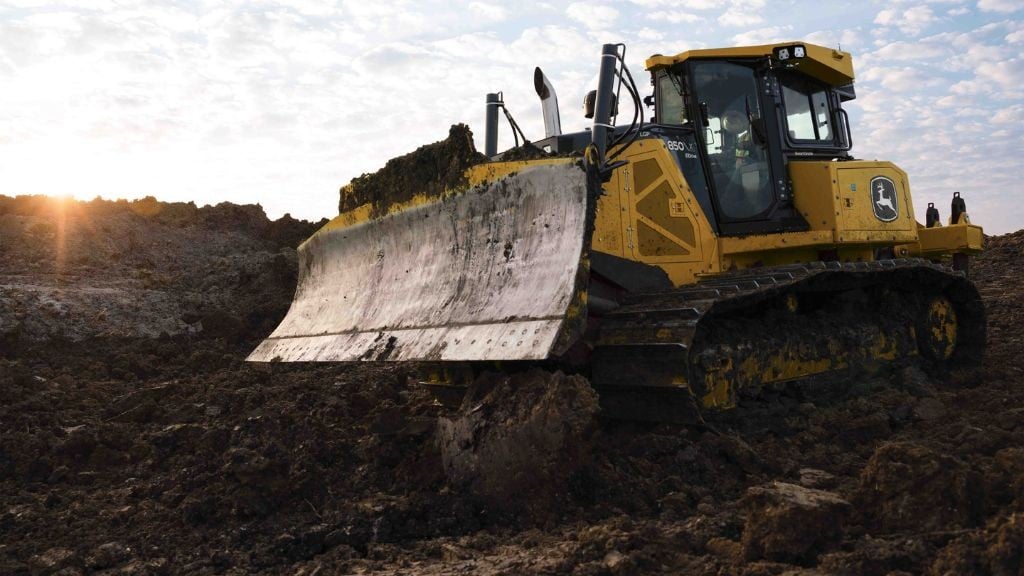
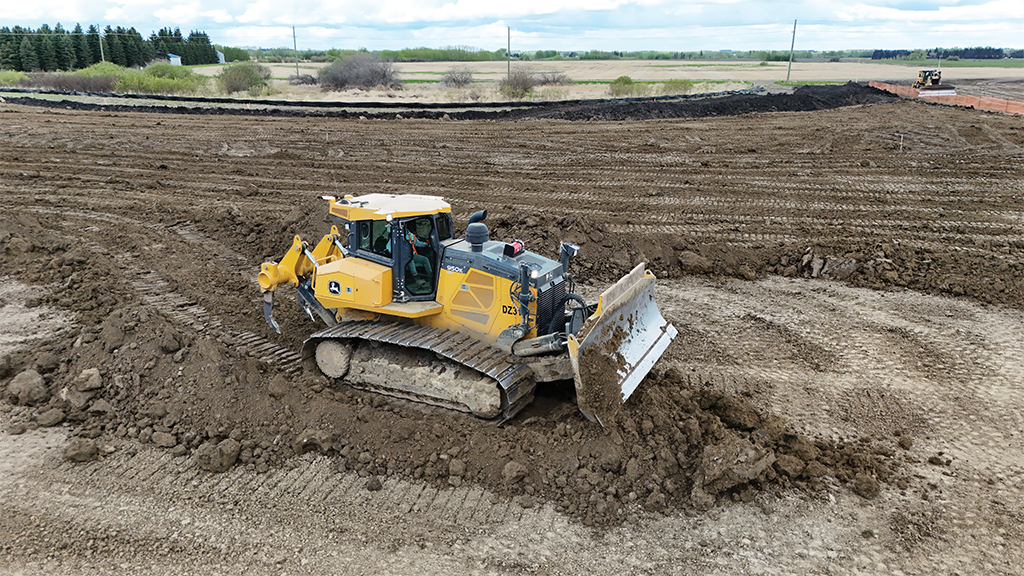
"We were one of the first in Edmonton to run 3D machine control on equipment in our area and are typically the first in Canada to buy new-model equipment with technology, for example, the John Deere 850 X-Tier E-Drive dozer. We try to be an early adopter of technology. Our goal is to always be ahead of the competition," says WCL General Manager Andrew Kent.
The company uses machine control on motor graders and dozers with plans to put it on mainline excavators when they launch their new underground division. WCL also uses drones, handheld units, and positioning technology for surveying.
How machine control technology works
The process begins with satellites that triangulate to create a digital map of the construction site. GNSS antennas mounted on the machine receive signals from these satellites to determine the equipment's exact position relative to the digital map with centimetre accuracy.
Contractors need a corrected GNSS signal, which is transmitted from a base station set up on site or a virtual network, which receives the GPS signals, corrects them to achieve survey-grade accuracy, and broadcasts them to the machine.
In the office, detailed 3D models are created to show the design surface, elevations, slopes, alignments, and any other project elements. The models are uploaded to the machine's onboard computer to provide a complete digital blueprint of what needs to be built.
The 3D system compares the machine's current position and the location of its attachment, such as a bucket or blade, to the target design surface stored in the 3D model. The system then displays visual guidance on the cab screen showing how much to cut or fill or automatically adjusts the attachment hydraulics to match the design grade exactly. Operators see real-time information that shows whether they're on grade or if they're cutting too deep or not deep enough. As the machine moves across the site, the system makes micro-adjustments constantly, ensuring the finished surface matches the engineered design specifications on the first pass.
"The 3D machine control puts the machine on grade every time," says Hendriks. "The machine does the rough digging in manual mode, and then on the last pass, the machine takes control for absolute accuracy and brings it to grade down to the centimetre."
Another benefit to using this technology is it records as-built elevations that accurately document the as-constructed project. These are useful for proof of completion, legal protection, maintenance, and future builds.
Junior operators achieve quality results
It's no secret that the construction industry is facing a significant and growing shortage of skilled operators, a challenge that is reshaping how companies approach workforce planning and technology adoption. Fortunately, machine control technology can help.
"In Alberta, skilled, experienced operators are getting harder to find. Using machine control gives us the opportunity to get a more junior operator to run the equipment," Kent says. "It also increases our efficiency and reduces costs, time on site, fuel, and machine wear."
Liorti appreciates that machine control empowers Metric to maximize productivity. "With labour shortages and tighter schedules becoming the norm, we need to make the most of every hour on site. Machine control allows us to do more with the same crews while improving accuracy and consistency across our projects."
There is also less dependence on surveyors with machine control technology, which allows companies to reallocate resources. "You get more out of your active fleet of workers. For an experienced operator it makes their job easier, and for a newer operator it makes them more productive," says Hendriks. "It's also safer to have the machine doing the work rather than having someone in a trench directing operations."
It benefits the operators themselves. "Early adoption of technology allows our operators to grow their skill sets and gives us an advantage when bidding complex projects that demand accuracy and speed," says Liorti.
And it helps with recruitment. "If you're at the cutting edge of technology, you're going to attract new workers much easier," says Hendricks.
Machine control keeps equipment moving and productive
Machine control saves on survey costs, rework, materials, equipment hours, wear and tear on machines, and fuel cost. "Efficiency wise, it can reduce the time spent on site fine grading by 30 percent," says Kent. "It helps operators understand the project from the onset to reduce rework. Operators can easily adjust their grades and take off, for example, six inches and another six inches and systematically tackle the grade work with GPS. We had a couple jobs installing geocomposite liners with 25-millimetre maximum grading tolerances, and we were able to accomplish that with motor graders and dozers equipped with machine control."
In Liorti's experience, the technology keeps machines moving and allows operators to stay focused on production instead of stopping to verify grades constantly. Over time, that translates into better margins and more predictable project outcomes. Metric has used machine control on several large infrastructure and transit-related projects across Ontario, where accuracy and productivity are critical.
"These systems allow us to move large volumes of material efficiently while maintaining strict design tolerances," says Liorti.
Hendriks notes that the precision of the technology saves on material costs. "If you add even a quarter inch of extra material because you dug deeper than intended, that's profit you've lost. If you're always on grade, you don't have that problem."
The return on investment is quite quick, depending on the size of jobs. "Some customers have reported paying for it on the first, second, or third jobs, because they're saving money on so many levels," Hendriks says.
Intuitive and user-friendly systems are easy to learn
Adrian Colan is a senior surveyor at Metric who uses the technology on a daily basis. "For me, it was very easy to learn. Its user-friendly interfaces definitely reduce the learning process and time for operators, as compared to traditional technology."
Kent from WCL agrees. "Our experience with it has been that it's efficient, very user friendly, and it saves time. We started using it on one machine. When we saw the results, we got more systems. It's just gotten better year after year."
Machine control has become a competitive necessity
As construction projects grow more complex and margins tighter, 3D machine control technology has gone from an optional upgrade to a competitive necessity. Companies like Metric and WCL show that early adoption isn't just about staying current, it's about fundamentally reshaping how work gets done. By turning operators into precision specialists, reducing reliance on scarce skilled labour, and delivering measurable savings in time, materials, and rework, machine control addresses several industry challenges.
The technology's intuitive design and quick ROI make the transition accessible, while its impact on accuracy, efficiency, and profitability makes it indispensable. In an industry where every centimetre and dollar counts, machine control isn't the future of construction — it's the present for companies determined to lead instead of follow.
Sabrina Cataldo is a senior copywriter at Brandt.
This article originally appeared in the July/August 2026 issue of Heavy Equipment Guide.