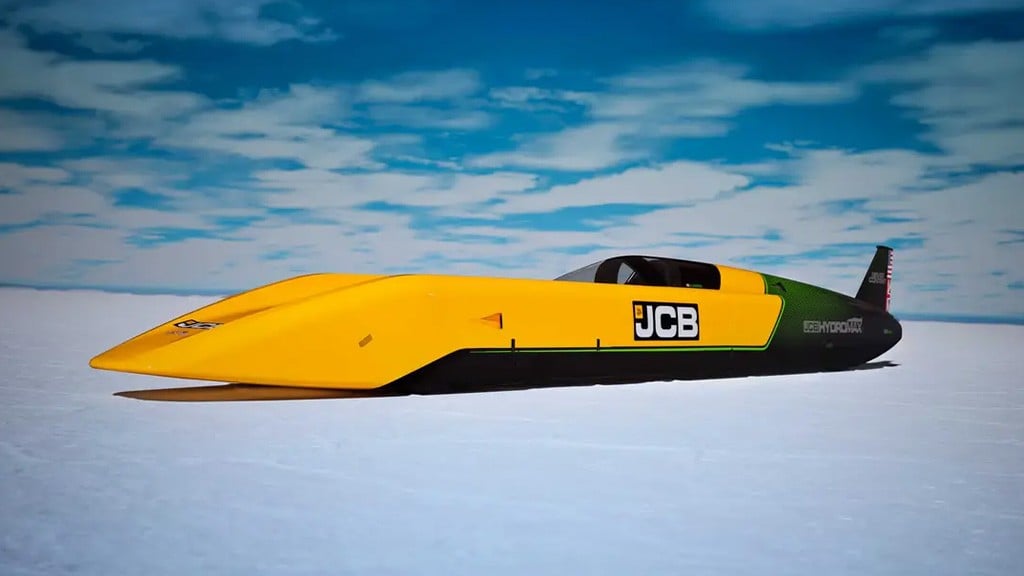

JCB tests Hydromax in preparation for hydrogen land speed record attempt
JCB Hydromax is powered by two hydrogen-combustion construction equipment engines
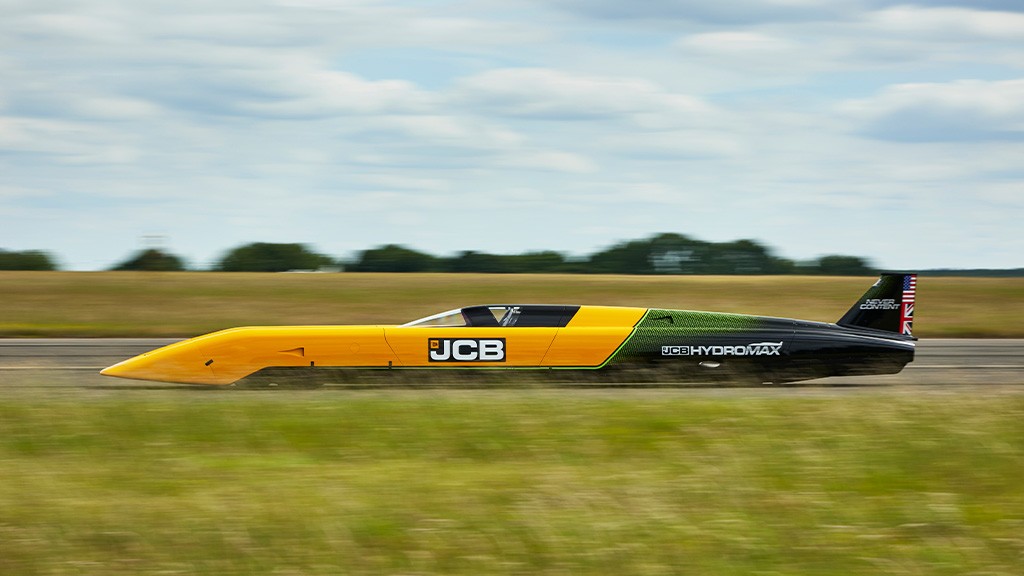
In May, JCB revealed that it will attempt to set a world hydrogen land speed record that tops its own 2006 diesel world land speed record of 350.092 mph. The Hydromax car is powered by two JCB hydrogen-combustion engines, and the company has announced that testing at RAF Wittering in Cambridgeshire, England, achieved a speed of 177 mph on June 16.
In July, the car will be flown to Bonneville, Utah, in preparation for the record attempt on the Salt Flats, where it will be piloted by Wing Commander Andy Green OBE. Green is the fastest man on Earth at 763.035 mph, and the only person to break the sound barrier on land. Green was the driver of JCB Dieselmax when it set the FIA world diesel land speed record at Bonneville in August 2006. JCB says that Hydromax is lighter and offers more power than Dieselmax.
The FIA, the global governing body for motor sport and the federation for mobility organizations worldwide, will be present and oversee the attempt to set the Fédération Internationale de l'Automobile (FIA) world hydrogen land speed record.
JCB demonstrates the viability of hydrogen combustion
JCB Chairman Anthony Bamford has spearheaded JCB's £100 million investment to develop hydrogen-powered internal combustion engines, and JCB earthmoving machines powered by the technology are currently rolling off production lines.
Lord Bamford said, "Twelve months ago, this car was a set of drawings being discussed by a room full of engineers. Today, it is a reality and on wheels, running, and being tested in the U.K. The team has done a wonderful job to get us to this point. Our focus now turns to the real challenge: setting a world hydrogen land speed record in Bonneville."
JCB Engineering Director Ryan Ballard, who is leading the project, added, "More than 150,000 hours of work has got us to this point; the next phase is where we find out what the car actually does, not what we think it will do. Every run, every refuel, and every tire change we complete in the U.K. is one our team won't be doing for the first time on the Salt Flats. Our goal is simple: to arrive at Bonneville fully prepared, with a car and a crew that know exactly what they are doing."
President of the FIA, H.E. Mohammed Ben Sulayem, said: "JCB Hydromax's first official test marks an important milestone on the road to a new hydrogen land speed record. This is a big achievement, and I would like to extend my sincere congratulations to Lord Bamford and the entire JCB team. Through this world record attempt, JCB is pushing the boundaries of engineering innovation and hydrogen technology, demonstrating the role motorsport can play to advance the future of mobility. I look forward to seeing the project continue to develop ahead of its world record attempt in August."
How JCB engineered the Hydromax to excel under extreme load
The initial technical partner meeting for the project with JCB, Prodrive, Ricardo, and Xtrac was held on June 5th, 2025, and almost a year to the day, the 32-foot JCB Hydromax rolled onto the tarmac at RAF Wittering for its very first run under its own hydrogen power. This marked the start of a full U.K. test program covering shakedown runs, hydrogen refuelling drills, and pit-stop rehearsals.
The JCB Hydromax is powered by two of the company's own production-based hydrogen internal combustion engines, producing a combined 1,600 bhp — the same engines now powering JCB earthmoving machines.
It has been built to a rigorously engineered design. Around one kilometre of wiring runs through the car, and extensive use of 3D-printed components was used to keep weight down and packaging tight. The crankshaft is the same one JCB uses in its 448 hydrogen and diesel engines — highlighting how the land speed car is built on production hardware.
Keeping that hardware working at full power is a key engineering challenge. The pistons alone require one litre of cooling oil every second — as much oil flow as the rest of the engine combined — to stop them from overheating. A specially developed exhaust valve technology handles the temperatures generated by 1,600 bhp of hydrogen combustion. Each titanium turbo compressor spins at more than 150,000 rpm at roughly 300 degrees Celsius, pumping the equivalent of a standard bathtub of air every half-second.
On a full run, JCB Hydromax will consume just over two kilograms of hydrogen and produce 18 litres of water.
The U.K. testing puts every system under load for the first time: the powertrain, four-wheel-drive transmission, clutch, brakes, cooling, and bespoke control electronics. Hydrogen refuelling drills bring the pit crew, the on-car systems, and the fuel supply together at full pace, while pit-stop and tire change rehearsals will sharpen the turnaround times that, at Bonneville, can decide whether a record run goes ahead or not.
JCB to attempt the record this August
In early August the team will attend SpeedWeek, Bonneville's land speed racing event, run by the Southern California Timing Association (SCTA). The team will then remain at the Salt Flats to pursue officially recognized world records under the FIA.
JCB has a long history of pushing land speed limits. In 2019, the JCB Fastrac tractor was crowned the world's fastest tractor at 135.191 mph, and in 2014, the JCB GT set the world record for the fastest backhoe loader at 72.58 mph.