
Heavy Equipment Guide marks a milestone
40 years of iron, innovation & industry change
Heavy Equipment Guide has documented the machines, technologies, and people shaping the construction equipment industry in Canada for four decades.
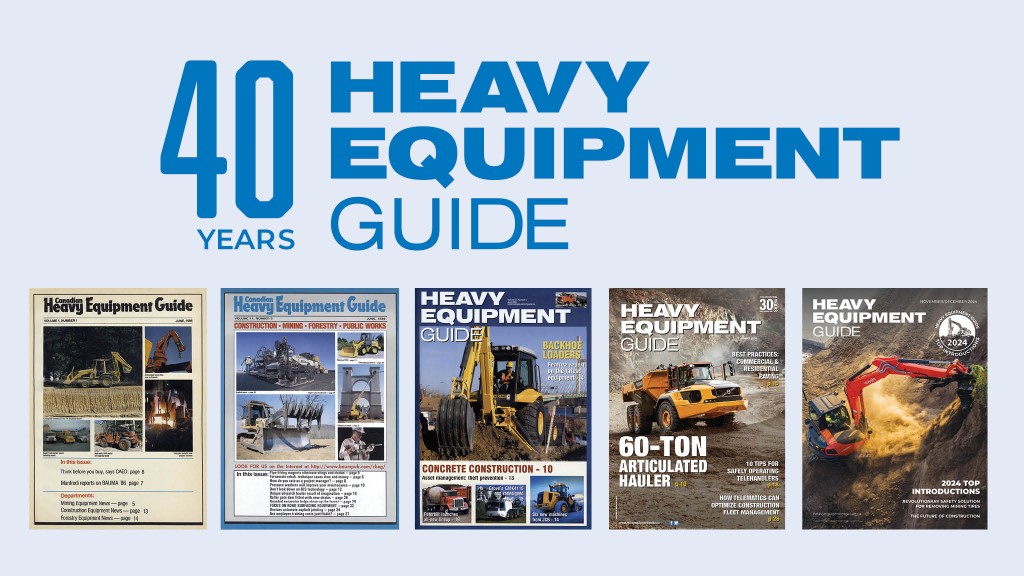
In our first issue, June 1986, under the headline "We're off and running hard," Heavy Equipment Guide founder Engelbert J. Baum wrote about the vital role of information in the construction equipment industry. "The better informed you are, the better decisions you eventually make, whether that involves the purchasing of equipment, a maintenance technique, or a new type of operation." In every issue since, Heavy Equipment Guide has strived to be the trusted Canadian source for connecting contractors, equipment owners, dealers, and manufacturers.
Innovation through the decades
Heavy Equipment Guide's founding coincided with a significant industry transition. The 1980s marked the shift from purely mechanical machines to hydraulically advanced equipment with electronic monitoring systems. Excavators became faster, smoother, and more precise, while diagnostic systems began appearing in heavy machinery for the first time.
Compact excavators, skid steers, and compact track loaders exploded in popularity as urban construction expanded and contractors demanded more versatile machines for tight job sites. Hydraulic attachments transformed compact equipment into multi-purpose tools, and smaller contractors gained access to highly productive equipment without investing in large fleets.
The introduction of GPS-guided dozers, graders, and excavators in the 2000s changed earthmoving forever. Operators could now grade to exact specifications using satellite guidance and digital site plans. The benefits have been transformative: reduced rework, lower fuel consumption, and dramatically improved accuracy are a boon to productivity and profitability.
Equipment also became connected through telematics platforms, allowing owners to remotely monitor machine location, fuel use, idle time, maintenance intervals, and operator performance. Fleet management shifted from reactive response to data-driven, proactive decision-making.
Through these digital innovations, OEMs have evolved into technology providers in addition to manufacturing equipment.
In the 2000s, Tier 4 emissions regulations forced OEMs to redesign engines and exhaust systems to reduce particulate matter and nitrogen oxide emissions, injecting major R&D investment across the industry. Cleaner machines, improved fuel efficiency, and simplified treatment systems eventually evolved out of the Tier 4 Final regulation, but the transitional period introduced new maintenance requirements for equipment, and contractors had to adapt.
Electrification also developed over recent decades, starting with mining, lift, and compact earthmoving equipment. While electric machines remain niche and suited to specific applications, the variety of electric equipment solutions continues to grow.
Forty years of equipment and technology innovation has culminated in job sites that remain familiar but are now underpinned by an invisible ecosystem of data, technology, and people driving unprecedented efficiency.
Our purpose is to provide insight
Like the construction industry, publishing has undergone monumental transformation in recent decades. Heavy Equipment Guide has evolved from a tabloid print magazine to a letter-size magazine format with growing digital and multimedia platforms. In 2025, we published our first Excavators issue — an industry-first special edition print and digital magazine dedicated to one equipment category.
Over 40 years, our purpose hasn't changed. We report from industry trade shows and job sites and connect with OEMs, dealers, and equipment owners. Visits to OEMs at their proving grounds, where we get in the dirt to learn from their experts and try the equipment for ourselves, are further opportunities to provide practical insights for equipment buyers and contractors.
When covering the latest news, equipment, and technology announcements, our role is to situate innovation in the industry and present new solutions in a range of contexts. Heavy Equipment Guide's readership encompasses civil contractors, small-to-mid-size construction firms, owner-operators, and other industry stakeholders. Factoring in Canada's geographical diversity — including climate, economic, and industry variability — adds another layer to the insight we deliver.
While the latest technologies are incredible, iron is still the foundation of construction work, so we aim to cover equipment and technology with an eye on the essential markers of success for any construction business: productivity, profitability, quality, and safety.
Whether that success is achieved with the latest 3D machine control and data-driven insight, a workhorse machine that's reliable in the dirt every day, or something in between, our focus on solutions remains grounded in providing information that can help you solve problems today and plan for the future.
Thank you for your support
We are grateful for the many relationships built over the 40 years with our readers and partners.
To our readers, thank you for continuing to subscribe to our magazine. To our many advertisers over the years, thank you for your continued trust and support.
To the entire Heavy Equipment Guide team, past and present, thank you for your hard work and collaboration.
For 40 years, Heavy Equipment Guide has chronicled the machines building our world and the people driving the industry forward. The next chapter promises to be just as transformative.
This article originally appeared in the May/June 2026 issue of Heavy Equipment Guide.