
How to take a boom lift's productivity to the extreme
What you need to know to safety and efficiently complete work at extreme height
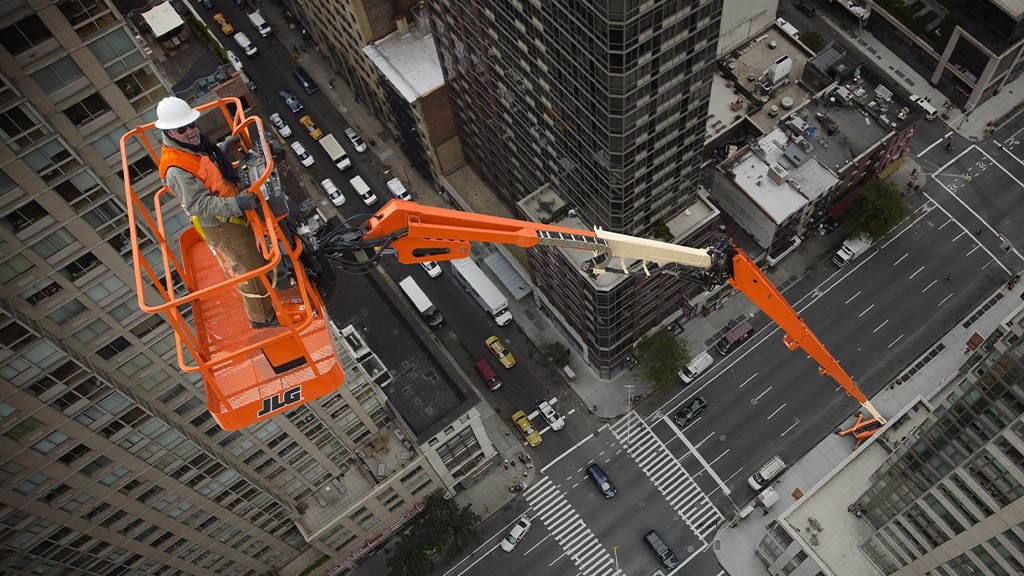
Urbanization has become a significant driver for many equipment design and technology trends in the access industry. With less open space, buildings are becoming taller, and the distance between them is narrower. As buildings go up vertically instead of out horizontally, the demand for higher-working, farther-reaching equipment is on the rise.
Equipment options for work at extreme heights
Historically, cranes were considered the only equipment capable of accessing job sites higher than 100 feet in the air. But, cranes are only designed to lift materials, not people. With buildings and other structures (think bridges, cellular towers, electrical transmission substations, shipyards, stadiums, steel mills, and oil and gas refineries) getting taller, the need to get workers to height has changed what type of equipment can be used to get work done.
Aerial work platforms are the solution when the work requires lifting people in the air. But when the work requires lifting people to extreme heights (defined as greater than 100 feet), only a few types of aerial devices can go that high, including truck-mounted aerials, mast climbers, suspended work platforms, and self-propelled boom lifts.
Let's take a brief look at each of these options.
Truck-mounted aerial work platforms can rival a crane's lifting height, today going up to more than 300 feet in platform height, and they have the advantage of being designed to travel on roads so they can get to and from different job sites. The disadvantage is that they need to be driven by a professional driver, and they are rented with the driver/operator, further adding cost to the project. Their on-highway chassis design can make these trucks more diffcult to manoeuvre once on site, especially across unimproved terrain.
Mast climbers are also designed to get workers up to extreme heights, but once installed this type of equipment cannot be moved until the work is done. That really limits its flexibility to be used in different locations across the job site. Another limitation is that a mast climber should be positioned on the ground, and many buildings have lower levels with a larger footprint than the tower. Mast climbers also do not have up-and-over reach capability.
Suspended work platforms are positioned at height by hoists or rigging systems that are either a permanent part of the building, on tracks that travel around the perimeter of the building, or can be temporarily installed. Like mast climbers, this type of equipment cannot quickly or conveniently be used at different locations within the job site. Still, it is most effective when servicing simple vertical surfaces.
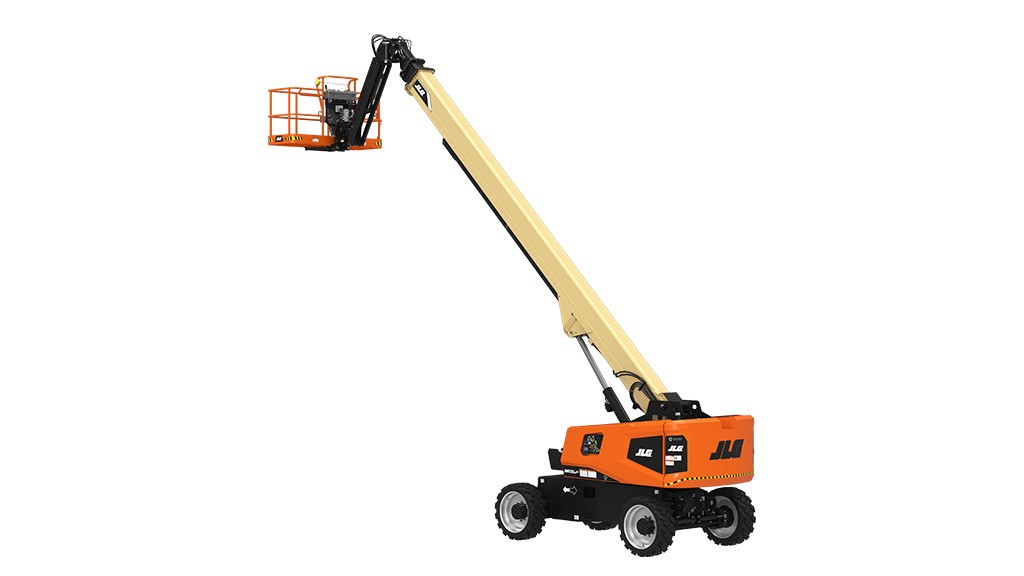
Self-propelled boom lifts, like the other equipment options mentioned, are purpose-built for this work. Their advantage is that they are designed to be driven while elevated; in fact, many models offer drive-at-full-lift-height capability so workers can keep going when overhead work requires them to move or reposition. These machines' compact footprint also allows them to be used in smaller, space-restricted areas.
As equipment design and technologies have advanced, along with innovations in safety features, many boom lift models can achieve great heights. The largest boom lifts on the market today provide the reach needed to put workers up to 19 to 20 stories high, translating to the ability for workers to get projects done 180 to 200 feet above ground level.
These advancements have led to increased demand for taller boom lifts. With that demand comes the need to explain what these machines can do and how they can do it. For example, a few factors need to be considered when making the equipment selection for work at extreme heights: the machine's chassis design and transportability, as well as its envelope control.
A strong base is the route to extreme height
Boom lifts' ability to achieve extreme heights is owed to what happens at ground level. A machine's chassis design is the secret to its stability, and making boom lifts stable at height may require a wider wheelbase, extra counterweight, or outriggers.
All of these design elements impact the machine's transportability. The higher a boom lift goes, the bigger and heavier the machine's undercarriage becomes. As a machine's weight and dimensions go up, it is less efficient to transport, and overweight and/or oversized load permits may be required for highway transportation.
This means that the size and weight of the machine's base are very important. To ensure stability at height and ease of transportation, boom lift manufacturers have to find the right balance between chassis size and weight in their machine design.
JLG Ultra Series boom lifts (models that reach 12-plus stories — 120 feet and higher), for example, are equipped with extendable axles. Hydraulic cylinder-deployed axles allow JLG boom lifts to grow from their transport width of 8 feet 2 inches to 16 feet 6 inches wide for exceptional rigidity and stability. These axles can extend or retract in less than one minute for ease of transportation and set-up. JLG's Ultra Series models utilize an electronic steering system, as there are no traditional tie rods on modern extendable axle machines, to keep the machine's steer wheels in the proper position.
Extreme height machines with extendable axles have one significant compromise — they lack oscillating axles and the ability of the wheels to follow ground imperfections is negatively affected. Keep in mind that this will reduce the machine's traction management. Although the machine will weigh less, it may not work as efficiently in certain ground conditions. Or, it may not be able to work at all if the ground hasn't been suitably prepared before the machine arrives on site. Before bringing one of these bigger boom lifts on site, it is important to confirm that the ground conditions can support the machine's weight during travel, as well as set-up and operation.
Today, new technologies like Building Information Modelling (BIM) are used to pre-plan projects that use these larger machines and can help planners understand how the ground conditions could impact the machine's operation. Because BIM provides architects, design engineers, and contractors with the most up-to-date specifications, models look and act as the real equipment would on the job. This provides a better understanding of how a larger boom lift can be used on a job site during planning and the early stages of a construction project. BIM can help to visualize the machine's placement and position to complete the necessary work, as well as how its length and width will impact its ability to manoeuvre in specific environments.
Going up is all about control
Self-propelled boom lifts become heavier when height increases and have a more extensive working base. But those are not the only contributors to the stability of a machine working at extreme heights. Another critical element is the envelope control system, which allows for maximum operating reach and height within given constraints of stability and structural design of the machine. Each machine has its own envelope profile and size, and the shape of the working envelope is a critical differentiator when comparing various machine models.
Electronic control systems limit working envelopes on large, modern boom lift models. These systems use information from sensors, usually a combination of boom length and angle sensors and load sensing devices, that continuously measure the boom position and control the position within the machine's predetermined work envelope. For example, these sensors can restrict the length of the boom based on its angle, and vice versa.
Another advantage of envelope control is that the same sensors and control systems can also provide the operator with very smooth machine operation. Advanced boom control systems also lead to better diagnostic capabilities because the information from the sensors can be used to evaluate a machine's state, either using locally deployed tools or remotely via telematics systems. With envelope control, a boom lift gains the advantage of multiple platform capacities on the same machine, giving users selectable envelopes based on the desired platform capacity ratings.
Work at greater heights with the right machine
As with any equipment selection, choosing a boom lift for working at greater heights isn't all about the machine's unique design elements and technology components. It's also important to consider what else will be needed to complete the work.
Factors to consider include knowing what materials and tools need to be lifted to the work area and the number of workers required at height. Job planning and operator training are critical components of successful projects, no matter how high the equipment goes. When preparing for work at extreme heights, it's important to consider how the machine will be transported, plan its movements on the job site, know the optimal boom positions needed to reach the overhead work and evaluate the ground conditions.
This information will help determine the machine with the right rated operating capacity, maximum platform height, and working reach to get the job done at any height.
This article originally appeared in the March 2026 issue of Heavy Equipment Guide.