
Rough-terrain cranes: new models built for smarter, safer lifting
Updated designs emphasize control, safety, and productivity in demanding environments
Rough-terrain cranes continue to evolve with smarter controls, enhanced operator assistance, and safer performance for demanding environments. The latest models are built for increased productivity across construction, infrastructure, energy, mining, and industrial maintenance applications where mobility, visibility, and efficient setup are essential. Advances such as proportional full-power booms, variable outrigger positioning, ergonomic tilting cabs, and integrated telematics are improving lift planning and everyday operations. With features like transport-ready design and electric power options, this new generation of rough-terrain cranes supports more precise, connected, and reliable lifting on today's constrained and complex job sites.
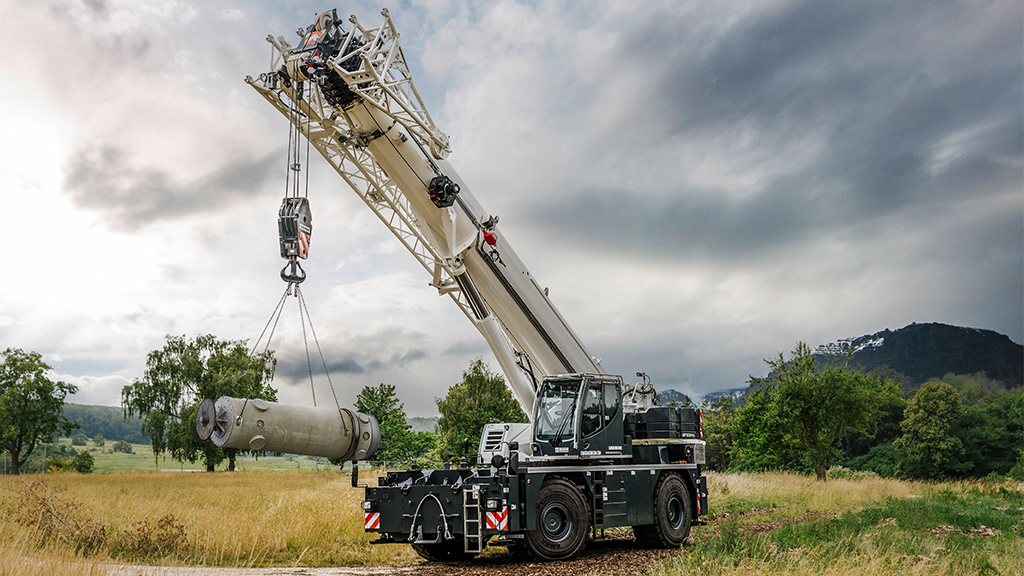
Liebherr LRT 1130-2.1
The Liebherr LRT 1130-2.1 features a 60-metre, seven-section TELEMATIK telescopic boom designed to support a wide range of lifting requirements. The boom can be extended and secured automatically through Liebherr's high-speed telescoping system, enabling operators to configure the crane efficiently on site.
Several boom extension options are available to increase reach and flexibility. A 10.8-metre single folding jib or a 10.8- to 19-metre double folding jib can be installed at 0, 20, or 40 degrees, with an optional hydraulic adjustment range from 0 to 40 degrees. When paired with an additional 7-metre lattice section, the crane can achieve hook heights up to 85 metres. The folding jib is stowed on the right side of the boom, while a 2.9-metre assembly jib can be mounted on the left. A side-folding rooster sheave with two-line capability further expands the crane's lifting configurations for different operational scenarios.
For transport, the LRT 1130-2.1 has a width of 3.4 metres, a height of 3.85 metres, and a chassis length of 9.4 metres. It can be moved at 48 tonnes with its folding jib and hook block, or reduced to 44.8 tonnes when needed. The counterweight system uses self-assembly ballasting rams.
Safety is built into both set-up and operation. An outrigger monitoring system automatically records whether the crane is supported on tires or outriggers, with ballast installation and optional jib configuration also tracked in the control system. VarioBase enables independent outrigger extension, with real-time capacity calculations based on the crane's exact stance.
Operator-focused features support visibility and controlled movement, including a tilting cab and safe-access points with ladders, grab handles, and an extending platform. Storage for lifting accessories and support materials helps keep the work area organized.
Powered by a 6-cylinder Cummins engine that can be used with HVO, the crane combines high tractive effort with excellent off-road manoeuvrability. A 6-speed powershift Dana transmission, large 29.5 R 25 tires, and all-wheel or crab steering modes ensure confident performance on uneven terrain and in restricted spaces.
Terex TRT Series
Terex expands its TRT Series with two new rough-terrain additions engineered for applications in ports, infrastructure, mining, energy, yard logistics, and general lifting. The lineup integrates a proportional full-power boom, four steering modes, and compact dimensions for confident movement on constrained sites. The TEOS operating system and T-Link telematics enhance fleet visibility and simplify operation, while Eco Mode improves fuel efficiency. A tiltable, high-visibility cabin and LED lighting support operator comfort and safety during long shifts and low-light lifts.
The TRT 100 delivers 100-tonne lifting capacity with a 47-metre boom supported by a 17-metre side-stowed jib for additional reach. A self-removable counterweight aids in transport and setup flexibility, and the new asymmetric outrigger system automatically adjusts allowable lifting capacity to match the available footprint, maximizing performance when used in confined areas.
At 60 tonnes capacity, the TRT 60 brings the same ergonomic design and smart control ecosystem to a lighter class. It features a 42.5-metre boom paired with an 8- to 15-metre stowable jib for variable height and offset requirements. Its compact size and four steering modes make it a practical fit for mixed-terrain lifting, fleet mobility, and high-utilization rental environments.
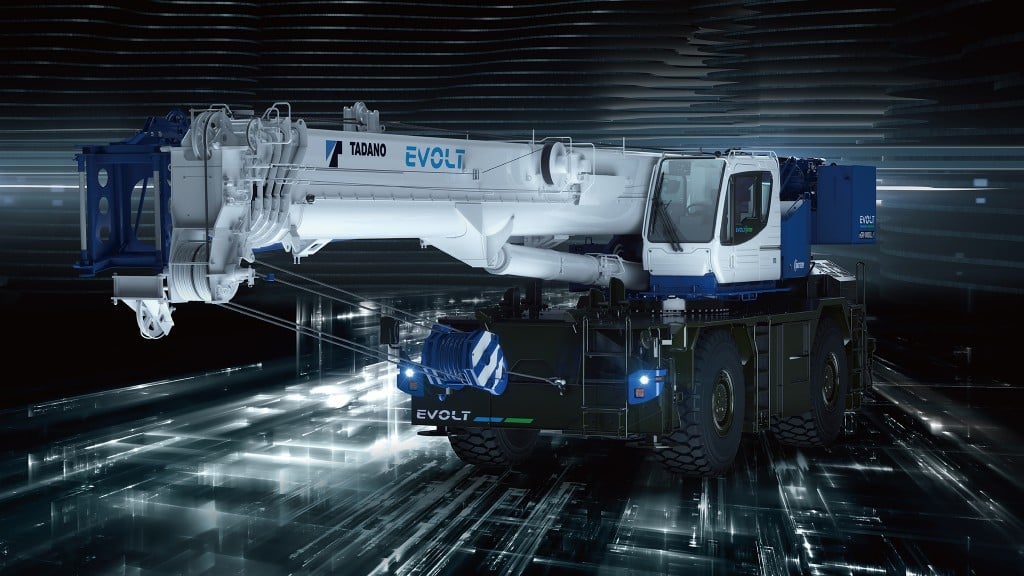
Tadano eGR-1000XLL-1
The Tadano eGR-1000XLL-1 is the first fully electric rough-terrain crane available in the U.S. and Canada, delivering the same 100-tonne lifting capability as its diesel counterpart in a zero-emissions package. Powered by high-performance lithium-ion batteries, it supports up to 7 hours of lifting on a single charge or a combination of lifting and job site travel. Plug-in operation enables continuous crane use when connected to on-site grid power.
Charging flexibility (480 VAC grid power or a CCS1 rapid charging system) helps fleets adapt to varying job site conditions. Standard charging via 480 V three-phase power supports full recharge in approximately 4.5 to 5.5 hours, while rapid charging shortens that window to around two to three hours. Regenerative braking improves energy recovery during operation, extending battery life and reducing overall energy consumption. Quiet operation significantly cuts noise levels, creating opportunities for nighttime municipal work and indoor environments with strict sound limitations.
The model incorporates Tadano's latest operator-assist technology. Lift Visualizer provides a direct overhead view of suspended loads with real-time lift parameters, helping improve awareness in blind-lift scenarios such as rooftop projects. The AML control system delivers comprehensive monitoring and setup assistance through an enhanced interface with on-board diagnostics and adjustable lift limits. Connectivity features include the EVOLT app, which tracks battery status, travel history, and operational information, and HELLO-NET telematics for fleet oversight, maintenance planning, and job documentation.
Manitowoc Grove GRT540
The Manitowoc Grove GRT540 is a 40-tonne rough-terrain crane designed for lifting performance on space-constrained job sites. It features a 31-metre four-section, full-power boom, with a telescoping swingaway extension ranging from 7.9 to 13.7 metres. Combined, these configurations provide a maximum tip height of 47 metres, supporting construction, industrial maintenance, and utility work in access-restricted environments.
Compact dimensions (under 2.6 metres wide) and a lightweight gross vehicle weight (29,200 kilograms) support straightforward transport and manoeuvrability on site. Four-wheel drive with four steering modes and fully hydraulic disc brakes enhance control in uneven or restricted conditions. The new Site Steering mode provides precise positioning.
Operation is managed through the CCS 1+ Crane Control System, displayed on a single 12-inch touchscreen. The interface provides real-time feedback on crane configuration, slope, steering, and travel speed. MAXbase variable outrigger positioning supports asymmetrical setups, with visual confirmation of operating limits shown directly on the display.
Visibility is supported by a three-camera system and full LED lighting. Integrated oCSI (On-Crane Service Interface) diagnostics and Grove CONNECT telematics provide on-board monitoring and remote fleet visibility to support maintenance planning and crane utilization.
This article originally appeared in the January 2026 edition of Heavy Equipment Guide.
Company info

1015 Sutton Drive
Burlington, ON
CA, L7L 5Z8
Website:
liebherr.com/en/can/about-liebherr/liebherr-worldwide/canada/liebherr-in-canada.html