
Sarens uses Liebherr cranes to lift and install 500,000-pound walking portal for Saskatchewan potash mine
Multiple cranes and high-capacity special rigging were used to lift and stabilize an uneven storage unit for potash recovery
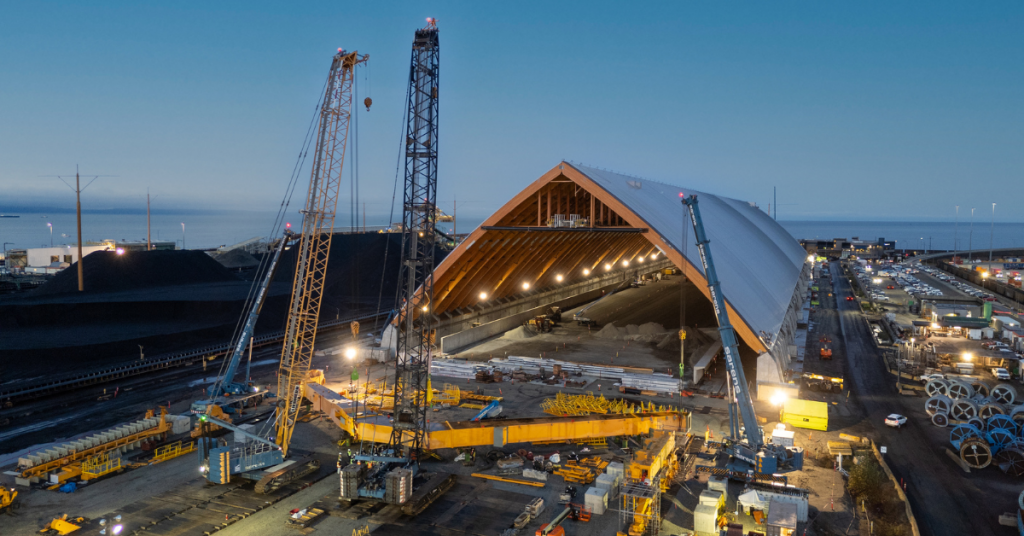
With the growing potash fertilizer market in Canada fuelled by global demand, Sarens contributed its heavy lifting, engineered transport, and Liebherr crane rental services to enhance a major project at a key Canadian potash mine.
The Canadian potash industry relies on strong infrastructure
The potash fertilizer market in Canada expects to see a compound annual growth rate (CAGR) of around 5.7 percent forecast between 2026 and 2035, supported by demand for potash for various agricultural applications in regions such as Manitoba and beyond, as well as more efficient and sustainable production practices with lower emissions intensity than other producing countries. The Canadian potash industry remains a key pillar for both global agriculture and the country's economy, as Canada produces and exports a significant proportion of the world's supply of this critical mineral.
In addition, global demand for potash is also expected to grow in the coming years, driven by global population growth, agricultural intensification and the need to improve crop yields, opening up vast opportunities for the Canadian sector. Expansion projects such as the Jansen Mine in Saskatchewan, set to become one of the world's largest mines with estimated production of several million tons per year by the end of 2026, reflect the commitment to consolidating Canada's position as a key supplier of this essential fertilizer.
Within this growth context, Sarens contributes its heavy lifting, engineered transport, and crane rental services with the assistance of Liebherr to enhance major projects with direct impact on the local economy. This contribution includes the lifting operation and installation of a 250 tons walking portal intended for potash recovery in a new storage shed. The structure had uneven leg lengths and an unbalanced weight distribution, requiring a carefully designed lifting solution. To raise the portal upright, a 250-ton crane was used on the lighter leg and a 500-ton crane on the heavier leg, while, once upright, a 440-ton and a 330-ton crawler crane worked together to support and stabilize the structure.
To complete the work, a high-capacity special rigging, supplied from the U.S., was required to allow a controlled transition between lifting points and facilitate the safe 90-degree rotation of the structure during the manoeuvre.
Liebherr cranes build essential potash storage shed
To execute the project, Sarens performed the lifting of 33 double arches composed of glulam arches, beams, purlins, support towers, and concrete anchor blocks, each with a 70-foot radius and weighing 80,000 lb. Sarens' engineering team conducted a thorough site and lift assessment, selecting a combination of 250-ton crawler cranes, 100-ton RT cranes, 250- and 120-ton all-terrain cranes, and a 55-ton truck crane, optimized for capacity, reach, and mobility.
The execution of this work has already positioned Sarens as an essential player in the Canadian potash sector, demonstrating its expertise in deploying the precise machinery and equipment according to the unique needs of each project.
According to Brett Allen, Sarens key account manager, "We are proud to contribute to the growth of this industry in Canada through projects that combine precision engineering, lifting capacity, and specialized transport. Our involvement in the installation of the walking portal and the expansion of the potash storage building at Westshore Terminals reflects not only our technical expertise and planning ability but also our commitment to safety and efficiency in every maneuver. Thanks to our team of experts and state-of-the-art machinery, we help ensure that strategic projects for the local economy and national infrastructure are successfully completed, consolidating our position as a reference partner in the sustainable development of the Canadian potash industry".
Company info

1015 Sutton Drive
Burlington, ON
CA, L7L 5Z8
Website:
liebherr.com/en/can/about-liebherr/liebherr-worldwide/canada/liebherr-in-canada.html