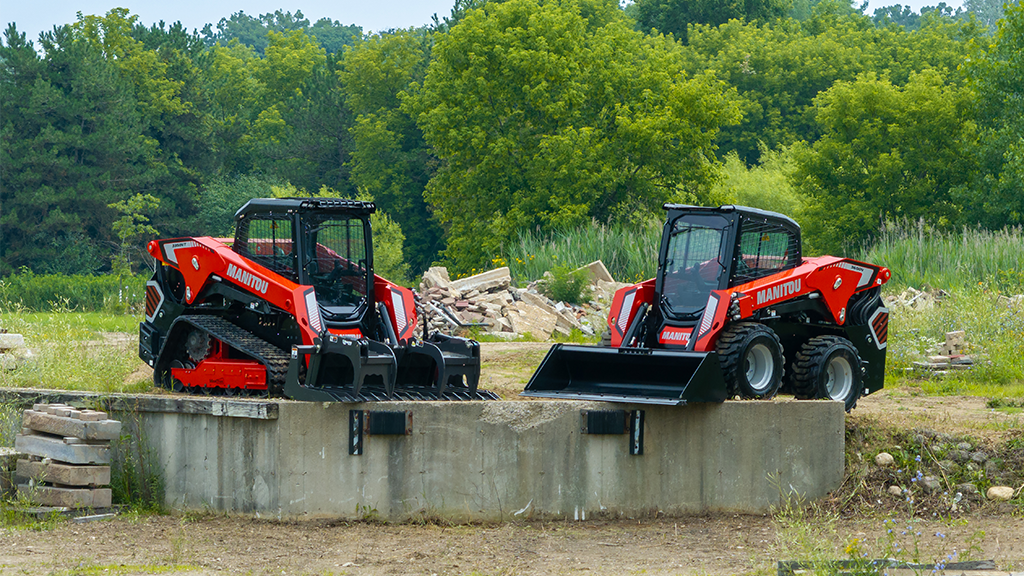

Compact track loaders with EH controls deliver enhanced precision and control
EH controls and high-flow hydraulics expand CTL capabilities beyond dirt moving
Compact track loaders, or CTLs, are more popular than ever before, and that's due in no small part to their incredible versatility. Available in a wide range of sizes and with a staggering number of productivity-boosting attachments, CTLs can come in handy on just about any job site, large or small. In fact, a skilled operator with a CTL and the right attachments can often do the work of multiple individuals — that's especially important in today's tight labour market.
The CTL evolution continues
Over the years, CTLs have advanced with more innovative features to meet changing operator and job site needs. Many now include around-view cameras with large monitors for better visibility when working in confined spaces and enhanced safety. These screens are also key for monitoring the machine's health, and this is also where much of the customization takes place, such as adjusting auxiliary hydraulic flow to dial in the performance of a hydraulic attachment. That's just the tip of the iceberg when it comes to advanced CTL features.
Speed-sensitive ride control reduces material spillage and creates a smoother ride for the operator. Auto two-speed shift allows the machine to automatically downshift when more traction is required for pushing into a pile, making sharp turns, or travelling uphill. Active power control optimizes engine speed and torque when under load.
CTLs that offer electric-over-hydraulic, or EH, controls, are even more customizable, seamlessly integrating with more advanced attachments for nearly effortless control and far greater productivity. While pilot controls were once standard on many CTLs, EH systems are now increasingly common as machines become more integrated with technology.
With hydraulic and electronic integration, these machines are no longer just dirt movers. They can do so much more, including clearing land with mulchers and rotary cutters or removing snow with advanced plows and snowblowers. These CTLs can prep sites for utility services by using cold planers to amend asphalt and concrete and trenchers to prepare for laying pipes and electrical or fibre-optic cables.
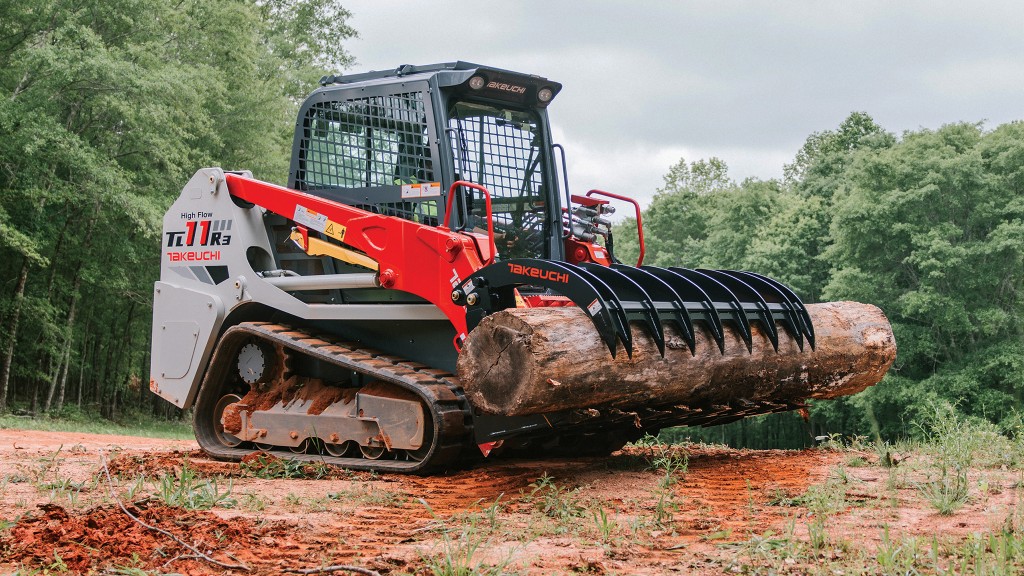
"Machines like our new Takeuchi TL11R3 reflect that shift," says Dylan Freeman, CTL product manager at Takeuchi-US. "They're not just built for moving dirt — they're designed to take on demanding attachment work, with EH controls and high-flow hydraulics that give operators more precision and power."
Greater functionality and customization
So, how do EH controls differ from pilot controls? EH controls send an electrical signal to hydraulics to control travel and boom and bucket control. Traditional pilot controls consist of a mechanical process where the joystick moves valves to divert hydraulic flow for movement. EH has the advantage over pilot controls because many more functions can be easily added via electrical signals and controls can be customized to fit operators' needs and preferences. The 14-pin connection to attachments on an EH-controlled machine can also often offer more versatility as it's easier to integrate additional attachment functions into the EH controls.
From an operator standpoint, EH controls allow for easier customization right from the CTL's monitor, such as specifying pattern and sensitivity level. This customization allows one machine to easily accommodate the preferences of multiple operators. Newer operators can set their EH controls to a slower response setting and switch to a faster setting as they become more accustomed to the machine.
"The available automatic features EH controls make possible can help newer operators be more productive, as they'll run the machine more efficiently," Freeman adds. "On an older machine with pilot controls, operators would have to manually engage these functions, and it might take a more experienced operator to do that correctly."
High flow for high performance
EH controls improve how operators interact with the machine, but to fully unlock a CTL's potential — particularly with powerful attachments — high-flow hydraulics are essential. The combination of flow (measured in gallons per minute, or GPM) and hydraulic pressure (measured in pounds per square inch, or PSI) can be used to calculate a CTL's auxiliary hydraulic horsepower. Typically, GPMs of more than 32-35 have been referred to as high flow. However, it's becoming increasingly common for high-flow machines to have a GPM of 40-plus, with pressures of 3,400-4,000 PSI.
"Attachments that are required to spin at high speeds, such as mulching heads or snow blowers and attachments that require lots of power to cut or grind through material, such as cold planers or stump grinders, are becoming more and more popular," Freeman says. "These types of attachments require lots of power to run and thus require a high-flow machine. Standard-flow machines fall short as their combination of flow and pressure doesn't generate enough horsepower for these attachments to reach the rotation speed or power needed to complete their tasks."
A smart, robust combination
When a CTL has both EH controls and high-flow hydraulics, those systems can truly complement each other in the field. For example, attachments with the ability to move in multiple directions will often require more input controls than the machine offers. This fact also holds true for attachments requiring constant power for multiple components, such as pick-up brooms or cold planers where the broom or milling head is rotating and the water tank needs power to supply water. EH controls can be adjusted to accommodate all these functions and more.
"An example of a job where the combination of EH controls and high-flow hydraulics come in handy could be when an offset cold planer or trencher is in use," Freeman says. "These attachments can pull the machine to one side. With the EH-enabled track compensation feature, the operator can adjust the flow to the drive motor on either side of the CTL and prevent that drift from happening. Meanwhile, high-flow hydraulics provide the horsepower needed to keep the attachment's drum spinning in dense material."
Other examples where the combination of EH controls and high-flow hydraulics are a must include the use of EH controls for smooth feathering through dense brush and precise boom movement around trees. In that situation, programmable flow rates and detents can reduce the risk of overloading the CTL. High-flow hydraulics are also a must for powerful snow throwing and effective operation in wet or deep snow. During snow removal, EH controls give precise chute rotation, deflection, and blade angling for a cleaner, more efficient result.
The combination of EH controls and high-flow hydraulics can also make it easier to fine-tune certain operator preferences or settings. According to Freeman, one time when this combination comes into play is when creep speed and high flow are used together for applications such as trenching.
"You can set the speed of the machine using creep mode," Freeman explains. "This way the operator does not have to worry about metering speed with the joystick while running the engine at max RPMs, which could result in uneven trenching or potentially stalling the machine if the operator travels too quickly.
A smart investment for a changing workforce
Overall, features like EH controls and high-flow hydraulics are changing the way contractors think about CTL ownership and usage. Together, the customization now available with EH controls and the increased performance of high-flow hydraulics make it possible for manufacturers to develop new attachments and optimize those that are currently available. Operators will become increasingly efficient as the already-versatile compact track loader becomes even more functional. Freeman believes that contractors running older CTLs or bare-bones models might want to make the investment in a machine with EH controls and high-flow hydraulics to become more efficient and broaden their service menus.
"The efficiency of an older or less-equipped CTL truly depends on the operator's proficiency," Freeman says. "As newer, less-experienced operators enter the workforce, these advanced CTLs can help ensure there's less of a drop-off in productivity. Newer machines like our TL11R3 model can simplify and optimize tasks that would have taken years of experience to master in the past.
"Time is money, and any time you can shave hours off a task, that's more money in your pocket. With the combination of EH controls to enhance customization and precision, and high-flow hydraulics to send greater power to the attachments, you can complete even larger, more difficult tasks with a single CTL."
This article originally appeared in the September 2025 issue of Heavy Equipment Guide.