
Cat's high-drive electric-drive dozer is built to push and engineered to save
Caterpillar’s D6 XE electric-drive dozer combines high-drive durability with electric-drive efficiency
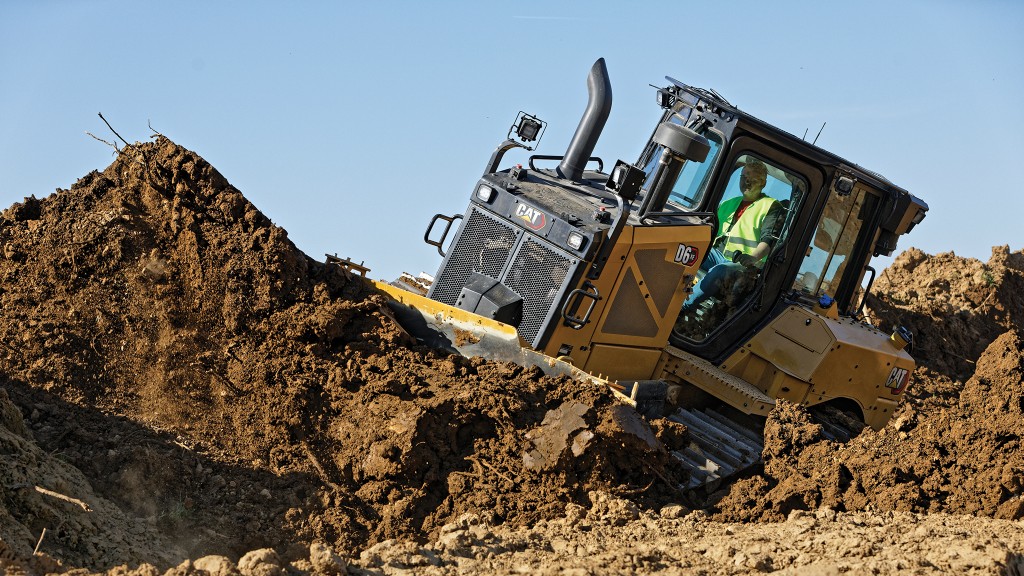
The Caterpillar D6 XE may be the world's first high-drive electric-drive dozer, but for operators stepping into the cab, it doesn't feel radically different — just better. That's by design.
Introduced in 2018, the D6 XE combines Caterpillar's high-drive undercarriage with a diesel-electric powertrain that delivers smooth, uninterrupted torque and up to 35 percent better fuel efficiency than its predecessor, the D6T. But it's not just about saving fuel. The machine's aggressive pushing power, intuitive assist technology, and lower long-term maintenance costs are redefining expectations for medium-class dozers.
"We were able to take customers that are very familiar with the old tractor and put them in this new one, and they're like, ‘Yeah, it's not different, it's just more powerful,'" says Sam Meeker, marketing professional at Caterpillar. "It feels like a really aggressive version of the regular D6."
That familiarity is part of what's made the D6 XE a seamless progression between convention and innovation. "One of our secrets to success with this tractor has been making it different but not so different that people are afraid of it," says Meeker. The form factor is recognizable, but the experience is next generation.
Under the hood of the D6 XE dozer
The D6 XE is designed to deliver exceptional fuel efficiency. The Cat C9.3B diesel engine feeds an electric generator, which powers the drive motor through the steering case and on to the final drives. This eliminates the need for a conventional transmission or torque converter.
The result is constant power to the ground with no gear shifting, reduced mechanical wear, and the ability to ramp into a load instead of bogging down.
"We like to run this machine at a lower RPM, not only for fuel efficiency, but then it allows us to lug up into a load," explains Meeker. "So when we pull the load on, instead of the tractor lugging down, it actually increases the RPM and the power output, maintaining that consistent torque."
The D6 XE features a switched reluctance electric motor and generator, an update from the older permanent magnet system used in Caterpillar's first electric-drive dozer, the D7E. The newer architecture is more power-dense and efficient. Unlike its predecessor, the generator doesn't require cooling.
"We only make as much power as we're going to use," Meeker says. "And we generate less heat than previous designs."
Fuel efficiency and life cycle value
Caterpillar identifies three pillars that define the D6 XE's value: fuel efficiency, lower total cost of ownership, and aggressive performance. The combination of performance, resource optimization, and serviceability supports Caterpillar's mission to lower life cycle costs.
Depending on the work cycle and the machine being replaced, contractors may see anywhere from 10 to 35 percent improved fuel economy. Fuel and productivity gains are most apparent during tasks like finish grading and truck-dump spreading, where second-gear torque plays a larger role.
The D6 XE also offers lower operating and rebuild costs. With fewer moving parts (no transmission, no torque converter, and reduced fluid consumption), Caterpillar estimates customers can save roughly $1 per hour on powertrain rebuilds.
"It can be up to roughly 60 percent of new machine price," says Meeker, referring to the cost of a full rebuild at the 10,000- to 15,000-hour mark. "So you could be getting a half-price dozer for that second life."
Even if customers don't rebuild, resale value is strong. "The [ability to] rebuild and the strength of the Cat dealer network and the parts network [help] keep that value of that tractor higher," says Meeker. "We can see anywhere between a $50,000 and $100,000 premium over our competitors at rebuild time based on used equipment sales data, including our own."
Where the D6 XE excels
The D6 XE is designed to perform across a wide range of dozing tasks, but its advantages become most apparent in medium-duty and finish grading applications where torque, speed, and fuel economy converge.
"In that truck-dump spreading application where you're in second gear, that's where we get that extra little bit of torque, and we're able to be a bit more productive," says Meeker. In heavier first-gear pushing, its drawbar pull is comparable to conventional D6 models. But as the work shifts from bulk material to spreading and finishing, the electric drive shows a clear edge.
"In finish grading, the advantage of the XE is going to be on fuel," Meeker explains. "We're able to use that lower RPM and that super-efficient powertrain to get the same work done while burning much, much less fuel."
Who's running the D6 XE?
From owner-operators to large corporate fleets, the D6 XE has found traction with a broad customer base. According to Meeker, medium-sized contractors — those running fleets of 20 to 50 machines — make up a strong core of adopters. These companies often operate in site preparation, commercial development, and roadbuilding applications, where machines are expected to perform a range of tasks from heavy dozing to finish grading.
The D6 XE also appeals to owner-operators, particularly those who spend time in the cab themselves. "They can feel it, they can experience it," says Meeker. "So the owner-operators say they really love this tractor."
Larger construction firms and even some quarries are also putting the D6 XE to work in tasks like stripping and stockpile maintenance. However, Meeker is quick to point out that the machine's value is best realized when productivity gains translate directly to the bottom line. "If you've got somebody working solely by the hour . . . that's probably not the customer for an XE," he notes. In cases where billing is based on time rather than output — such as consultant work in oil field support — the fuel savings and performance gains may not fully offset the initial investment.
Operator experience and technology integration
While the D6 XE incorporates advanced assist features and is grade- and autonomy-ready, Caterpillar designed the machine to accommodate all skill levels.
"We don't force you to use the technology. It's there. You can turn it on and use it if you want to, but we don't force an operator to use it," says Meeker. This approach appeals to both tech-savvy younger operators and more experienced users who value control. "I've got one particular operator that I deal with a lot," Meeker recalls. "His motto is, ‘If it makes my life easier at the end of the day, why wouldn't I want to do it?'"
Adoption in real-time
Caterpillar recognizes that even on fast-paced job sites, operators need accessible ways to explore new technologies. That's why the company has focused on integrating features that are easy to discover, intuitive to use, and available on demand. Meeker notes that idle time across typical dozing applications averages around 30 percent, providing short windows throughout the day for exploration and learning. "That's 18 minutes an hour that you're not working," he explains. "That gives you quite a bit of time to look around and maybe experiment."
To support operator adoption across all experience levels, Caterpillar offers on-demand learning resources through its online platform, catoperatortraining.com. Designed to be accessible any time and from any device, the platform is particularly valuable for operators, whether they're digital natives or seasoned professionals, navigating new technologies.
Meeker notes that he recently spoke with an operator in his mid-50s who was watching tutorial videos on his phone during a break. "He was looking up how to run a particular feature," says Meeker. "We're seeing more and more operators, regardless of age or tech background, making use of those tools to get more comfortable in the seat." The ease of access and modular format allow operators to learn at their own pace, building confidence with new assist features without stepping away from the job site.
Familiar form, future-ready performance
By combining the trusted high-drive undercarriage with a refined electric-drive powertrain and operator-focused technology, the Cat D6 XE stands out in the medium-class dozer segment. But Caterpillar also sees the D6 XE as a strategic stepping stone toward more integrated automation.
With more than 50 million hours of electric-drive experience across its product lines, and over two decades of implementing 3D grade control, the company has steadily introduced assistive technologies that could pave the way for future autonomy. As part of Caterpillar's medium-dozer lineup, the D6 XE benefits from a modular platform that enables regular updates to machine control, assist features, and performance technologies.
"It's just a great machine," says Meeker. "We get a lot of customers, a lot of operators, that run it for even a few minutes or a week or a month, and they come back and say, ‘I never want another dozer.'"
With impressive fuel efficiency, lower cost of ownership, and aggressive performance built into its DNA, the D6 XE is engineered not just to work harder, but to work smarter for the long haul.
This article originally appeared in the September 2025 issue of Heavy Equipment Guide.