
Electric earthmoving equipment proves its power and potential over diesel machines
Battery-powered earthmoving machines are matching diesel performance while cutting emissions, maintenance, and noise
Battery power is revolutionizing construction equipment. Advances in lithium-ion batteries, the need to reduce CO₂ emissions, and demand for quiet, low-emission machines are driving manufacturers to invest heavily in electric innovation. Contractors can now access compact and mid-size machines that operate in urban and sensitive environments without sacrificing performance.
Different approaches to electric construction equipment
There is no one-size-fits-all solution for low- or zero-emissions construction equipment. Manufacturers are taking various approaches to electrification across machine types, including compact excavators, track loaders, wheel loaders, and backhoe loaders, with mid-size machines beginning to appear.
JCB: Early leadership in electric excavators
JCB established an engineering department dedicated to electric construction equipment years before launching its first fully autonomous electric mini excavator in 2019, according to Chris Lucas, excavator product manager.
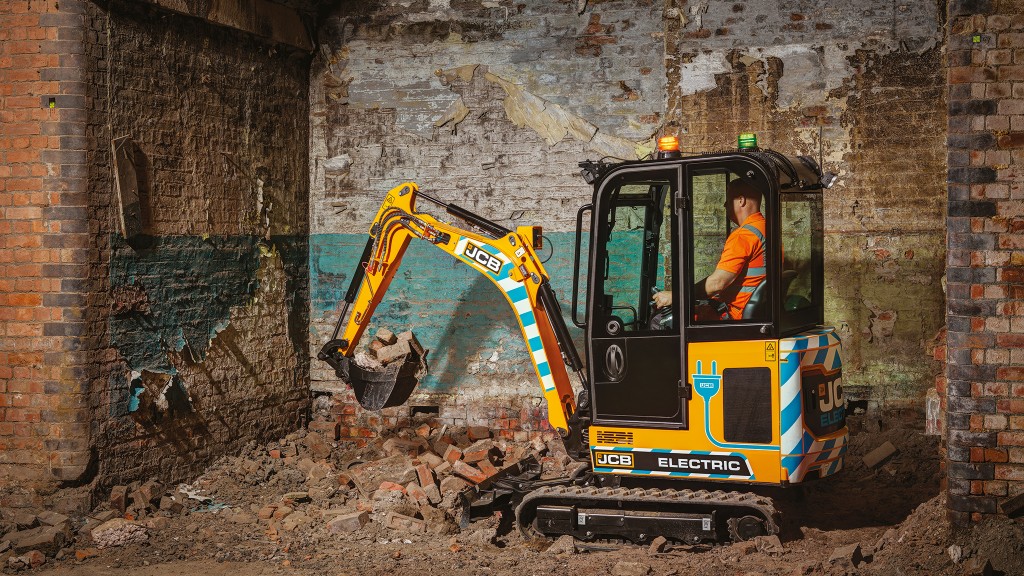
The E-TECH 19C-1E 1.9-tonne electric mini excavator debuted at the 2019 Rental Show in North America and has since added a cab option.
"What may surprise you, and it surprises a lot of people, is that the electric product actually delivers more torque, on immediate output, than the diesel variant. So as far as power and performance, there is no sacrifice," said Lucas.
Volvo CE: Compact machines go electric
Volvo Construction Equipment offers the ECR25 compact excavator and L25 compact wheel loader. In 2019, the company announced it would cease new diesel R&D for compact machines, committing fully to battery-powered development.
"What they particularly focus on is the fact that it's quiet, it's clean, and there's no vibration, but the performance and the characteristics of the machine are exactly the same as a diesel [machine]," said Ray Gallant, vice president of product management and productivity.
Volvo CE continues to develop prototypes for larger and mid-size electric machines, including the EX03 electric wheeled excavator, which features a rear video screen for safety messaging.
John Deere: E-Power prototype backhoe
John Deere's E-Power program focuses on understanding customer needs and developing solutions that add value. The E-Power prototype matches the performance of the diesel-powered 100-hp 310L backhoe loader while providing lower operating costs, reduced noise, and zero tailpipe emissions.
"It begins with gaining an understanding of customer needs, pain points, and value drivers. Translating this input into solutions that unlock value for customers is essential to development direction and eventual sale of new products," said Brian Hennings, product manager.
Testing includes National Grid job sites, with tasks such as trenching, backfilling, and truck loading to evaluate real-world performance.
CASE Construction Equipment: 580 EV backhoe
CASE unveiled the 580 EV, the world's first production-ready electric backhoe loader, at CONEXPO-CON/AGG 2020. Developed with Green Machine and Moog, the machine was tested with utility companies in the U.S.
"The backhoe loader is perfectly suited for electrification as the varied use cycles, from heavy to light work, provide an excellent opportunity to convert wasted diesel engine hours into zero consumption battery time - yet provide the operator with instantaneous torque response when needed," said Eric Zieser, director of global compact equipment product line.
Green Machine and Bobcat partnership drives electrification
Green Machine offers battery-powered mini excavators in sizes from 1.7 to 4.5 tonnes and supports OEM electrification efforts. Bobcat has partnered with Green Machine to retrofit mini excavators and develop an electric compact track loader.
How do electric machines stack up against their diesel-powered counterparts?
While there are many obvious benefits to operating a battery-powered machine, the ultimate test is whether the machine can deliver the same performance as its diesel counterpart while providing a contractor or rental house with the ability to take on new jobs that may not be suited to diesel machines.
"What may surprise you, and it surprises a lot of people, is that the electric product actually delivers more torque, on immediate output, than the diesel variant. So as far as power and performance, there is no sacrifice," said Lucas.
With a diesel machine, whenever the operator goes to dig, the engine has to gear down to get the horsepower to pull through, whereas an electric product has continuous power. The same voltage and the same power surges through the machine regardless of the task.
Referencing the CASE 580 EV, Zieser said, "At low idle a diesel engine has reduced torque and requires time for the engine to ramp up to meet the load demands. Electric motors, on the other hand, have instantaneous torque and peak torque available at every operating speed."
According to Leandro Lecheta, head of CASE Construction Equipment North America, "The CASE 580 EV is equal in breakout force to diesel-powered backhoes in the CASE product line. It provides lower daily operating costs while also producing zero emissions. This allows it to work in tight spaces and enclosed working conditions."
Battery-powered machines cost roughly double their diesel counterparts, so factoring in the long-term savings when making a purchasing decision is key. Something else to factor in, if you work in enclosed environments, is the cost of renting exhaust extraction equipment. Other benefits include low noise levels, which may allow you to work after-hours in noise-sensitive environments.
Lucas had one customer who worked in highway construction, which he noted is not an industry that he had thought would be a target for electric products. This contractor was putting in culverts underneath a highway and to do one job cost over $3,500 in rental fees for exhaust extraction equipment. Utilizing an electric machine eliminates that cost.
Technicians at JCB dealers go through high-voltage training, but on the whole, Lucas noted that electric machines need far less servicing than machines with diesel engines - another significant long-term cost savings.
According to Lucas, a study that compared the E-TECH mini excavator with the diesel equivalent machine found that over a three-year span the electric machine saved 48 percent on the cost of servicing. With a JCB electric machine a daily inspection involves walking around the machine to make sure that there are no tears in wires and that hydraulic levels are right, but there is otherwise no checking of oil, changing oil filters, or maintenance of a diesel engine. "From the operator's perspective, it's really quick and simple," he said.
Who benefits most from electric construction equipment?
Electric construction machines come with a higher upfront cost than their diesel counterparts, but the long-term advantages are significant. Beyond eliminating fuel costs, these machines require less maintenance, produce minimal noise, and generate zero emissions. This allows them to operate in sensitive or enclosed environments where diesel equipment is restricted, such as hospitals, schools, tunnels, or urban areas.
These advantages open opportunities for contractors and rental companies to take on a wider range of jobs while reducing operating costs.
Utilities lead early adoption
Utility operations are among the first major markets embracing electric construction equipment. CASE, John Deere, and Green Machine have all partnered with utility companies to test their machines, and the sector continues to show strong potential. CASE's first production models of the 580 EV backhoe loader were delivered to utility companies in the United States.
According to Brian Hennings, product manager at John Deere Construction & Forestry, utility providers and government entities recognize the value of zero-emission machines.
"Utility providers and governmental entities see value in backhoes with zero tailpipe emissions."
He added that lower noise levels also make electric machines ideal for projects in densely populated or sound-sensitive areas, as well as for work inside buildings or tunnels.
Rental fleets expand electric offerings
The rental industry is quickly adding electric compact equipment to its fleets. Cooper Equipment Rentals became the first North American customer for JCB's electric mini excavator.
According to Rod Lentino, rental fleet manager, one of the key advantages of the JCB model is that it meets Canadian underground safety standards.
"One of the things that we liked about the JCB excavator is that it is approved for underground use and meets Canadian safety standards for underground applications."
That capability has allowed Cooper Equipment Rentals to support mining companies in northern Ontario, where electric excavators are used with breakers to recover ore from delicate sections of older mines. These machines are also valuable for cleanup and material handling in confined underground spaces.
Beyond mining, Cooper Equipment Rentals has deployed its JCB electric excavators for indoor projects, including installing moving sidewalks at Vancouver International Airport and performing renovation work across British Columbia and Ontario.
Market growth and outlook
Electric construction equipment remains in the early stages of adoption, but the outlook is strong. As production scales and supply chains mature, prices are expected to fall.
Ray Gallant, vice-president of product management and productivity at Volvo CE, predicts that the economics will improve as demand rises.
"Like any technology, as supply chains develop and demand increases, the sticker price will come down."
For now, success lies in identifying the applications and customers that will benefit most — those who value clean operation, reduced noise, and the ability to work where diesel equipment cannot.
What do contractors need to know about batteries, charging and maintenance of an electric machine?
As is the case with adopting any new technology, contractors are going to have a few concerns about battery-powered construction equipment.
According to Aaron Kleingartner, product and dealer marketing manager for Doosan Infracore North America, the customer typically has two questions about electric equipment. The first is how the performance of the electric machine compares with the diesel equivalent machine - does the machine provide the same, or better, breakout force and lifting capability, and are you able to use the electric machine in the same fashion as the diesel equivalent? The second concern is over how long the battery lasts - can the machine be used for a typical full work day?
Doosan is designing its first electric machine to address both of these concerns. Kleingartner noted that the second question is the harder one to answer. The machine can be designed to meet the criteria, but the run time is dependent on the environment that the machine will be used in. He added that the goal is what would be considered a traditional eight-hour workday. Doosan's DX17Z-5 electric prototype has been designed to have two charging modes, a normal charging mode with a 110-volt input or a faster charge with a 220-volt input.
With a diesel machine, as long as it's maintained and you're putting fuel in it, it can run 24 hours per day. Like Kleingartner, Lucas noted that extending the run time is a key challenge. JCB's 19C-1E can run for a typical full day's work, but the challenge is making machines that can run for that full day regardless of application.
Lucas added that another challenge is having the right power source at the job site for recharging the machine - JCB offers three different options for charging its lithium-ion battery pack based on where you are and what power sources you have available. JCB's power options for E-TECH equipment are: standard 110 volt, like you would find in your house; a 220-volt faster charge, but not everywhere is wired for that voltage; and 480-volt fast-charge option. The fast charge is an external unit that requires specific wiring and can fully charge a machine in two hours. Charging at 110 volts takes ten hours and charging at 220 volts takes around eight hours.
Developing and testing prototypes
There has been a flurry of new development announcements over the last few years, and while the first electric earthmoving machines available or in development were mostly compact excavators, OEMs are branching out into other types of machines and larger size classes.
John Deere will be testing its E-Power backhoe loader prototype with National Grid, an electricity, natural gas and clean energy company that serves 20 million customers in the U.S. northeast. According to Hennings, the testing will be done on several job sites to gain a robust, representative composite of their machine tasks and applications in varying weather conditions.
National Grid uses backhoe loaders for the development, maintenance and repair of their underground delivered utilities. Daily tasks performed in testing the E-Power backhoe could include self-transport to job sites, trenching, digging around utilities, truck loading, backfilling, site clean-up and more. Hennings noted, "Gathering operator feedback on machine performance and ease of operation will be critical in proving out the concept and ultimately the program's direction."
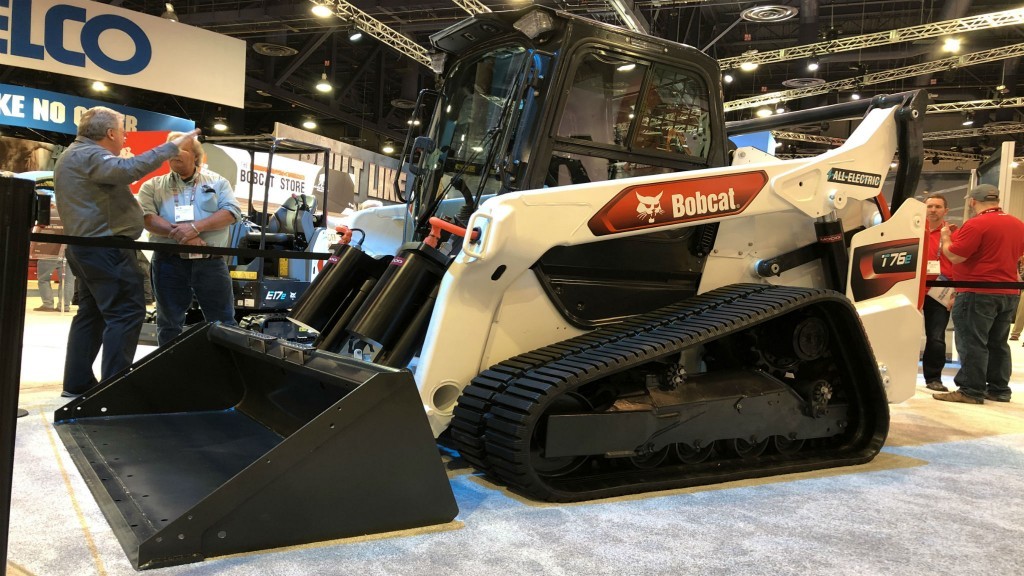
Bobcat is developing an electric compact track loader, which the company displayed at CONEXPO-CON/AGG in 2020. The concept machine include components from Moog and Green Machine and Bobcat says that a major innovation in the T76e is controllability of horsepower and performance through electronic mechanics instead of the traditional hydraulic and diesel system.
Doosan is testing the electric equivalent to its 1.7-tonne DX17Z-5 mini excavator. It is estimated to be available in North America in early 2023. Takeuchi and Hyundai (in partnership with Cummins) are also developing electric compact excavators, and Gehl demonstrated an electric skid-steer loader concept at CONEXPO-CON/AGG 2020.
Volvo CE has been providing insight into testing new propulsion technologies for years, including the development of the prototypes for its first electric compact excavator and electric compact wheel loader. Now the company has unveiled another prototype - an electric wheeled excavator with a unique feature that goes beyond its propulsion system. In addition to being electric, the mid-size EX03 features a video screen on the rear of the machine which delivers safety messaging to pedestrians and drivers.
In early 2021, Komatsu announced that it has partnered with Proterra to use Proterra's high-performance battery systems for development of mid-size electric machines. A proof-of-concept electric excavator is expected to be completed in 2021, with commercial production expected to start between 2023 and 2024. The Proterra battery system powering the electric excavator will feature high energy density and fast charging technology. According to Proterra, the packaging flexibility of its battery platform allows for optimal placement within a mid-size excavator and will replace the need for a normal counterweight.
Is the future electric?
While it's still early days, the activity in development and introduction of electric-powered earthmoving equipment has come a long way in just a few years. As we move into a future where there are greater demands for emissions reduction, battery power is here to stay as a key part of the construction industry - and there are more alternative propulsion technologies in development.
At the launch of CASE's 580 EV backhoe at CONEXPO-CON/AGG 2020, Hubertus Mühlhäuser, CNH Industrial chief executive officer at that time, commented that the world of diesel, as we know it, will come to an end. Whether that happens 100 years from now, in 50 years, or in 20 years or less, diesel will eventually be replaced by different forms of propulsion.
Ziesler from CASE has noted that the 580 EV is just the start of the company's approach to low- or no-emissions equipment. "We're proving the viability of electrification at the larger end of the compact and light equipment spectrum," Zieser said. "Our goal now is to further expand electrification and alternative propulsion into other product lines and markets that will also see the benefits from these advances related to sustainability and performance."
According to Gallant, Volvo CE is looking at more lines of its equipment that can be outfitted with battery technology, and he anticipates that other technologies, like hydrogen fuel cells, will come into play for some of the larger equipment.
Gallant also anticipates that laws will require that contractors make sure their construction equipment is clean and quiet for work in urban areas and populated areas. "If you look to what society is doing, the drive for sustainable power is becoming quite widespread."