

Making the Grade
Hauling 37 tons up a 45-degree incline
On the Canadian side of the Niagara River, there are two existing water tunnels under the city of Niagara Falls, both constructed in the 1950s using drill-and-blast techniques. The tunnels take water from the Niagara River 1.6 kilometres above Horseshoe Falls and feed it to the Sir Adam Beck power stations located eight kilometres downstream.
The Niagara Tunnel Project, headed up by Ontario Power Generation (OPG), is the latest venture to capture the river’s energy.
The new tunnel will provide an additional 500 cubic metres/second (17,700 cubic feet/second) of water flow, enhancing this green source of renewable energy.
OPG needed to enlist the right companies to carry out this monumental task. The job was bid out. Strabag of Austria was selected as design build contractor. Strabag charged The Robbins Co. of Solon, Ohio with designing, manufacturing and delivering a new tunnel boring machine that could excavate the 14.44m (47.3-foot) diameter tunnel through the sedimentary bedrock at Niagara. Dufferin Construction Company, a division of Holcim Canada, was subcontracted for site preparation, blasting at both ends, excavation of the overburden and haulage of all tunnel muck, as well as installation of the concrete gate structures at both ends.
A ‘boring’ process
The project started in the fall of 2005 when the world’s largest hard-rock tunnel boring machine (TBM) – nicknamed “Big Becky” by a sixth grade class (after Sir Adam Beck) – started its dig near the power station heading toward the Falls.
“A great deal of the TBM was assembled on site,” said Dave Pimpinella, Dufferin project superintendent. “This saved transport time and cost. It took four months of assembly and preparation before Big Becky was ready to start cutting away.” She’s electric powered and armed with a cutting head that weighs more than 440 tons, features 85 disc cutters and delivers torque that ranges from 9,025 kNm (high speed) to 18,800 kNm (low speed).
The TBM was designed for hard rock, but the geology is quite varied, consisting of limestone, dolostone, sandstone, shale and mudstone. Most of the rock is Queenston shale. The softer stone has been a challenge to safely excavate and support with resultant overbreak in the tunnel crown, slowing production.
“The TBM was designed to basically thrust itself against the hard, side tunnel walls and drive forward while cutting,” said Infanti. “When the side walls are soft or brittle, the TBM doesn’t get optimum cutting thrust.”
This is one of the reasons the project completion date has been pushed back from late 2009 to 2013. The projected price tag has risen from $1 billion (CAD) to $1.6 billion.
As of September 2009, the TBM has bored 5,400 m (3.4 miles) toward the 10,160m (6.35-mile) finish line. TBM progress to date has averaged about 5 m (16 feet) per day. On average the tunnel is 90 m (300 feet) below the City of Niagara Falls.
When the TBM advances forward, wire mesh, rock bolts and steel ribs are installed to support the tunnel crown. Shotcrete up to 30 cm (12 inches) thick is then sprayed in to reinforce the tunnel perimeter. Later, a cast-in-place final concrete lining will be installed to arrive at a final inside diameter of 12.8 m (42 feet).
Hauling up 45 degrees
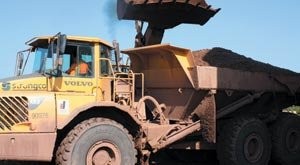
At the other end of the tunnel, the intake area is being prepped. Below the river bedrock, with the Niagara River kept at bay by a temporary cofferdam, the tunnel has been started – but only excavated to about 300 m (1,000 feet). “It’s been roughed out, braced, meshed, reinforced with shotcrete and pre-grouted,” said Pimpinella. “Eventually Big Becky will break on through to connect the openings.” This end of the tunnel is where the Volvo A35E and A35D articulated haulers are making the daily climb down, up and out of the tunnel intake entrance 37 metres (120 feet) below the rocky river bottom.
The haulers creep down the 45-degree incline in reverse. At the bottom lies a waiting excavator that quickly fills the haulers with 37 tons of blasted and excavated limestone rock. Then the Volvo A35 heads back up the incline. The steep, main climb is roughly 60 m (200 feet) long. When the loaded hauler gets near the top of the gaping, blasted-rock canyon, it has to make a complete right turn and go up another short incline – this time at a 48-degree angle – dump the rock and do it again. “When re-flooded with river water, this area will become a 2-to-1 slope with a catch pit to help prevent rock from entering the tunnel,” said Infanti.
As for the Volvo haulers, “Volvos were the only trucks that could make that climb,” Infanti explained. “We tried out the others and they just couldn’t make the grade. We needed a solution. Strongco Equipment told us it would be Volvo. It was.”
Dufferin does a lot of business with the Strongco branch based out of Mississauga. “Dufferin is a big customer of ours,” said Anna Sgro, Strongco Vice President, Multi-Line Division. “Their work changes and varies so they like to long-term lease a lot of their machines. We help them with a variety of machines to see which one fits. We told them that Volvo would handle a 45 degree climb.
“It’s the Volvo transmission, engine and torque converter,” Sgro continues. “The drivetrain is optimized with every part having been developed by Volvo to work together, to get the maximum rimpull and get you in and out of where you need to go.”
Strongco, the largest Volvo Construction Equipment dealership across Canada with over 25 branches, has been working with Dufferin Construction since 1985.
Trust is a big part of their dealer relationship, whether it’s turning the key to start the day or picking up the phone to find a new equipment solution.
Dufferin had three Volvo A35 articulated haulers – one A35E and two A35Ds – so the comfort level was already there.
“The Volvos are really nice,” said Dufferin operator Wayne O’Hagan as he drove the artic up the 45-degree slope. “I’ve got good visibility, a rear camera, air conditioning – even a stereo.” After making the climb, O’Hagan wheeled around, backed up and dumped his payload of rock onto a large mound that is quickly providing a new bird’s eye view of nearby iconic Niagara Falls.
O’Hagan and the other Volvo artic hauler operators at the Niagara Tunnel also get more out of the powerful dump hydraulics, nine-speed transmission for smooth shifting, and heavy-duty axles with 100 percent dog-clutch-type differential lock. No daily or weekly service intervals mean they can get right to work – whether it’s up the steep grade or travelling growing distances to unload the 37-ton payload of excavated material at maximum speeds up to 57 km/h (35.4 mph).
Company info

1640 Enterprise Road
Mississauga, ON
CA, L4W 4L4
Website:
construction-equipment-st.nors.com