
It’s big news when the busiest stretch of road in a bustling major metropolis is closed for construction.
“There has been plenty of media attention on this project,” said Jim Jackson, Metro Construction Manager for Knife River’s Western Oregon Division. “It’s easy to understand why. Interstate 405 essentially connects all the other main arteries in Portland. This really is the busiest place we could have picked to do a paving job.”
High traffic volumes – in excess of 140,000 vehicles travel this six-lane stretch of road daily – made closing a portion of the interstate the most practical approach for construction. While that eased some pressures on crews, it also increased the scrutiny of operations.
“Everyone had their eyes on this project because of the volume of work to be completed, plus the inconvenience of closing this busy freeway each weekend,” Jackson said. This included the Oregon Department of Transportation inspection, which meant the stakes were very high in terms of hitting specs and completing the paving on time. While there was the potential for bonus to be earned, the contractor also faced penalties of $500 for every quarter hour the interstate was closed beyond the scheduled reopening.
Four weeks become one
The prime contractor was given four weekends, from 9 p.m. Friday to 5 a.m. Monday, primarily for asphalt paving. Knife River, subcontracted to handle the paving work, placed nearly 21,768 metric tons (24,000 tons) of asphalt across six total lanes – three in each direction – for a distance of about 4.8 km (3 miles) in two weekends. The work included inlaying the shoulders and nine on-off ramps, which were cold-planed to sub-base by the general contractor, with Knife River handling trucking haul-off of the asphalt millings. Knife River utilized over 45 trucks each weekend.
The general contractor milled the ramps Friday night at the beginning of the closure. During this time, two Knife River crews handled mainline levelling passes. The asphalt was placed on top of the existing concrete surface.
Specs called for levelling the rutted areas and a subsequent 12.7 mm (1/2 inch) surface lift across all travel lanes.
Early Saturday morning, three additional crews began ramp and shoulder paving. Mainline wearing surface paving began at 6 p.m. Saturday, with one crew placing 3,628 metric tons (4,000 tons). On Sunday, mainline work continued, while two crews handled the remaining ramp and shoulder work. The road was cleaned and re-opened before 5 a.m. each Monday.
The paving
End-dumps delivered mix to crews working on ramps, while belly dumps and windrow elevators were used on the mainline, said Bill Wilson, Knife River’s Metro General Superintendent.
“It’s about 18 miles (29 km) from the plant to the jobsite, so the haul took about 35 minutes,” Wilson said.
During mainline paving, the dump man monitored the temperature and trucks to make sure the windrow didn’t extend so far that the mix would cool. Yet he also kept a close eye on maintaining production. “There’s definitely an art to that,” Wilson said. The pace on the ramps varied, but production on the mainline was outstanding. “We’re placing over 400 tons (363 metric tons) per hour,” Wilson said. Knife River also met specs for density and smoothness. Achieving those goals, while reaching such high production levels, required quality communication. Four crew members typically wore headsets to help them monitor various facets of the operation and communicate with each other. “You can achieve that pace and reach quality goals as long as you communicate and follow the basics,” Wilson said.
Trucks hauling mix to the job carried between 22.2 and 23.5 metric tons (24.5 and 26 tons) of asphalt. For mainline work, asphalt was fed to the pavers by windrow elevators.
“The windrow elevators are the key to that type of production,” Jackson said. “They keep the pavers moving continuously, which is good for both production and smoothness.”
On ramps, Cat AP1055D and Cat AP655C Asphalt Pavers often worked in tandem. “It gave us flexibility with varying widths.” Wilson said. “It also enabled us to pave lane lines and paint the joints.”
Mainline paving widths reached 5 m (16.5 feet). On a typical weekend, the pavers would pave three to four panels at 3.6 to 4.8 m (12 to 16 feet). The easy screed adjustments were crucial, particularly when working with varying widths on ramps. “The Extend-A-Mat 10-20B is near and dear to our hearts,” said Chuck Barker, Knife River – Western Oregon’s Northern Asset Manager. “They’re forgiving and easy to work with. They hold adjustments. In fact, they’ll hold those settings for half a season if you set them up right.”
The versatility of the 10-20B screed was crucial on the I-405 project. “They’re heavy enough for freeway paving, but easy to adjust for commercial work,” Wilson said. “Using extenders, we’ve pulled up to 24 feet (7.3 m) without a problem.”
During mainline work, the AP1055D Asphalt Paver started at the beginning of the project and ran the entire stretch. It then would return to the starting point and place an adjacent mat. Sonic sensors read off the shoulder for the first lift. Subsequent lifts were placed by sonics reading off the recently placed lift.
Pavers on the ramps, meanwhile, “pulled in every direction,” Wilson said. “You have to make the pavers fit the situation.”
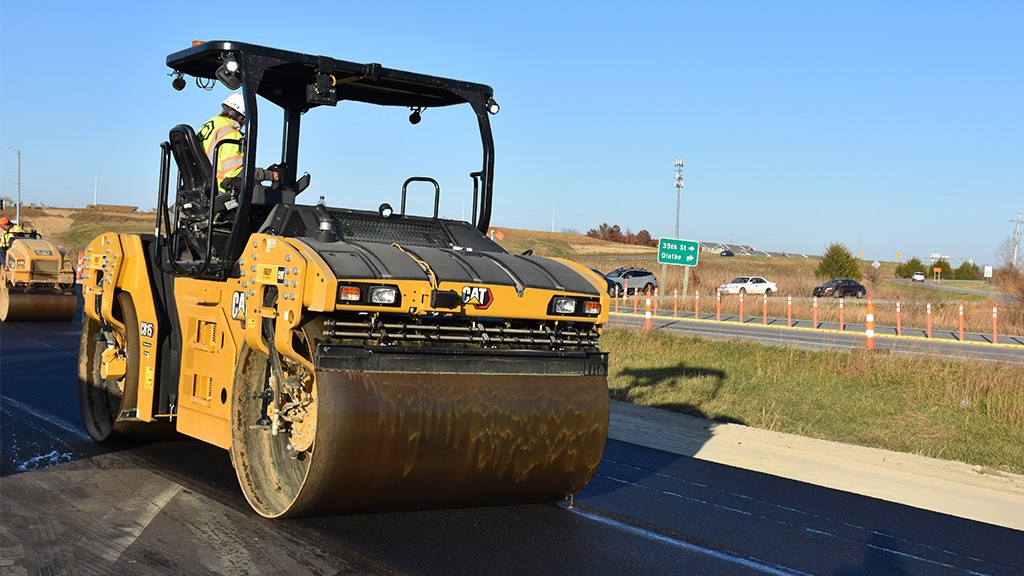
Cat CB-534D XW Asphalt Compactors handled both breakdown and intermediate compaction. A Cat CB-224E Utility Compactor handled finish rolling with static passes. Density was typically 92 to 94 percent at that point.
Finished ahead of time
The contract specifications allowed four weekends to complete the paving work. Knife River completed work in two: one weekend to pave a 4 km (2.5 mile) section of I-405 northbound, and the second to pave the southbound lanes.
“The time savings had a huge impact on all those involved with the project as well as the travelling public,” Jackson said. “The safety of our crews resulting from these full closures to traffic was the greatest benefit. “We’re proud of how this project turned out. We are able to walk away knowing we completed this project safely, with great quality and with a benefit to the community we live in. We set out to make this project a success and definitely accomplished that.”